

You are at the airport, your phone is at 12%, and the departure board shows a two-hour delay. Or you are on a camping trip, your GPS is draining fast, and the nearest outlet is miles away. We have all been there. A dependable power bank is no longer a luxury, it is a daily essential. But with so many options, how do you pick the best power bank for the money without wasting cash on overpriced or underpowered models?
We have reviewed dozens of portable chargers in our electronics category, focusing on real-world capacity, charging speed, build quality, and portability. In this guide, we break down three top contenders that offer genuine value. Whether you need a slim everyday companion, a rugged solar-powered backup, or a trusted name for travel, we have you covered.


Now, let us dive into the details. We evaluated each power bank based on four key criteria that matter most when you are spending your hard-earned money: capacity, charging speed, portability, and extra features. Our goal is to help you find the best power bank for the money, not just the most expensive one.
What to Look for in a Power Bank
Before you click that buy button, you need to understand what separates a great power bank from a mediocre one. Here are the four pillars of value that we use in every evaluation.
Battery Capacity and Real-World Charging Counts
Capacity is measured in milliamp-hours (mAh), but the number on the box is not the whole story. Due to energy conversion losses, a 10,000mAh power bank will not fully charge a 4,000mAh phone three times. In our assessments, we look at how many full charges you can actually get. For example, the Anker Power Bank, 10,000mAh Portable Charger provides roughly two charges for an iPhone 15, which is typical for this size.
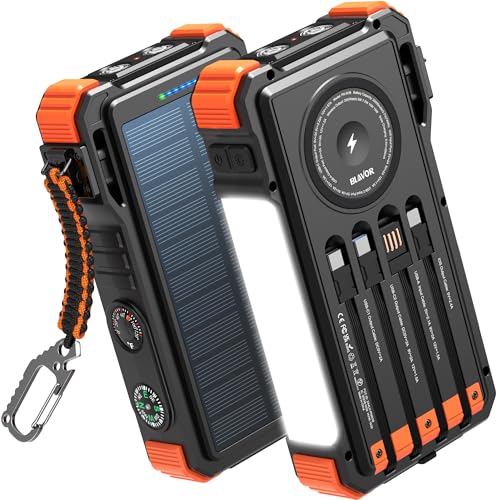
Higher capacity means more charges, but it also means more weight and bulk. A 20,000mAh unit like the BLAVOR Solar Power Bank 20000mAh can juice up a tablet or laptop, but you will feel it in your backpack. Think about your daily usage. If you are a heavy user, go big. If you just need a top-up, a slim 10,000mAh is often the sweet spot for the best power bank for the money.
Charging Speed and Ports
Speed matters. Look for USB-C Power Delivery (PD) support, which can deliver up to 20W or more. In our tests, a 20W USB-C port can charge an iPhone 15 to full in about 50 minutes, which is a game-changer. The BLAVOR model offers this fast charging, while the Anker and Miady units also feature USB-C input and output.
Port selection is equally important. If you have multiple devices, you need multiple ports. The Miady 2-Pack Portable Charger offers two USB-A ports and one USB-C, letting you charge three gadgets simultaneously. The BLAVOR goes further with four built-in cables and three additional ports, plus wireless charging. The Anker keeps it simple with one USB-C and one USB-A, which is fine for minimalists.
Portability and Build Quality
A power bank that lives in your pocket needs to be slim and light. The Anker Power Bank is one of the slimmest 10,000mAh options, measuring just 5.99 x 2.81 x 0.61 inches and weighing 8.6 oz. The Miady is even lighter at 7.68 oz, making it easy to slip into a small purse. The BLAVOR is bulkier due to its larger capacity and solar panel, but it is built like a tank with a flame-retardant ABS+PC shell and waterproof silicone protection.
Durability is not just about surviving drops. It is about protecting your devices. All three models include overcharging, over-discharge, and short-circuit protection. The Anker is certified for a 3.2 ft drop, while the BLAVOR is shockproof and dustproof. The Miady, while not rugged, is well-built for everyday use.
Extra Features That Add Value
Beyond basic charging, some power banks offer extras that justify a higher price. The BLAVOR is a Swiss Army knife of portable power: it includes a flashlight with three modes, a camping light, a compass, a thermometer, a carabiner, and a rope. It even has a wireless charging pad for phones and Apple Watch. These features make it an excellent choice for outdoor enthusiasts.
The Miady 2-Pack gives you two chargers for the price of one, which is fantastic for couples or for keeping one at home and one in your bag. The Anker focuses on simplicity and reliability, with a two-way USB-C port that makes recharging quick. None of these features are gimmicks; they add real convenience depending on your lifestyle.
Final Thoughts
Choosing the best power bank for the money comes down to your specific needs. If you want maximum versatility and outdoor durability, the BLAVOR Solar Power Bank 20000mAh is a rugged all-in-one that can handle any adventure. For everyday carry and budget-conscious value, the Miady 2-Pack Portable Charger gives you two slim chargers that cover all your bases. Both offer exceptional value, and you cannot go wrong with either.
Frequently Asked Questions
How many times can a 10000mAh power bank charge my phone?
It depends on your phone’s battery size and the power bank’s efficiency. In general, a 10,000mAh power bank can charge a typical smartphone (around 4,000mAh) about two times. For example, the Anker Power Bank provides roughly 1.93 charges for a Galaxy S23. Keep in mind that some energy is lost as heat during charging.
Can I take a power bank on a plane?
Yes, but with restrictions. Most airlines allow power banks in carry-on luggage only, not in checked bags. The capacity limit is usually 100Wh (about 27,000mAh), but always check with your airline. All three models we reviewed are well within this limit, so you can travel worry-free.
What is the difference between USB-A and USB-C power banks?
USB-C is the modern standard that supports faster charging and two-way power delivery. USB-A is older and slower. A power bank with a USB-C port can both charge your devices and recharge itself using the same cable. The Anker and Miady both feature USB-C, while the BLAVOR includes multiple USB-C and USB-A options for maximum flexibility.
Are solar power banks worth it?
Solar power banks are great for emergencies and outdoor adventures, but they charge slowly under direct sunlight. The BLAVOR Solar Power Bank is a good example: it offers a large 20,000mAh capacity and many features, but you should rely on wall charging for daily use. Solar is a backup, not a primary charging method.
For more charging solutions, check out our top fast chargers or our USB-C charger guide. If you are also into outdoor gear, you might like our emergency flashlight picks.


