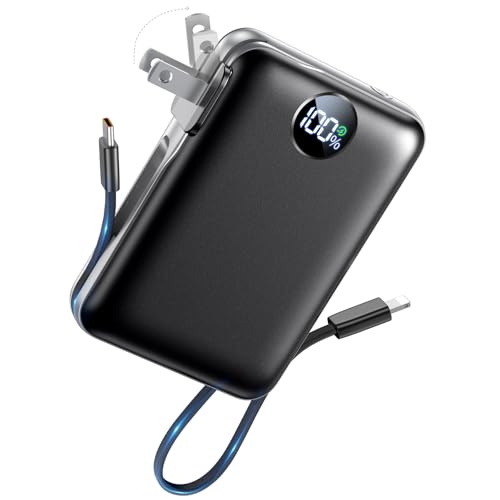
Imagine you’re on a multi-day hike, deep in the wilderness, and your phone battery is critically low. You need it for navigation, emergency calls, or capturing memories, but there’s no electrical outlet in sight. This is the exact scenario where a reliable solar power bank becomes an essential piece of gear. In 2026, solar charging technology has advanced significantly, making these devices more efficient and practical than ever before. Whether you are a frequent camper, a hiker, a traveler, or someone who simply wants a sustainable backup power source, this guide is for you. We have evaluated five of the best solar power banks on the market, considering capacity, charging speed, durability, and real-world usability. For our readers interested in other portable power solutions, we recommend checking out our 5 Best 20000mAh Power Banks for 2026: Top Portable Chargers Reviewed guide for more options.




Buying Guide: What to Look for in a Solar Power Bank
Capacity and Portability Trade-Off
A higher milliamp-hour (mAh) rating means more stored energy, but it also adds weight and size. For a weekend camping trip, a 20,000mAh bank might be ideal. For a longer expedition, you might need a 48,000mAh or larger unit, even if it is bulkier. Consider your typical usage: will you be carrying it in a daypack or stashing it in a car? Your choice should balance energy needs with portability.
Also, think about how you plan to recharge the bank itself. Larger batteries take longer to charge from the sun, especially with smaller solar panels. If you are always on the move, a smaller, faster-charging solar panel might be more practical than a massive battery that struggles to top off.
Solar Charging Efficiency and Panel Quality
Not all solar panels are created equal. Look for models with high-efficiency monocrystalline panels, as they convert more sunlight into usable energy. The number of panels also matters: multiple panels can charge faster in direct sunlight. However, keep in mind that solar charging is slow compared to wall outlets. It is best viewed as a supplementary charging method, especially for smaller devices.
Consider the wattage of the solar panel integrated into the power bank. A 5W panel, for instance, will take a long time to charge a 20,000mAh battery from empty.
Charging Speed and Output Options
Fast charging support, such as USB-C Power Delivery (PD) or Quick Charge (QC), significantly reduces the time it takes to charge your phone, tablet, or even a laptop. Look for a power bank with at least one USB-C port that supports high-wattage output. Additionally, multiple output ports allow you to charge several devices simultaneously, which is handy on group trips.
Wireless charging is an added convenience for compatible devices, but it is generally slower than wired charging. Built-in cables, while convenient, can sometimes be less durable than standard cables, so consider that trade-off. Also, check if the power bank supports pass-through charging, meaning you can charge the bank itself while it is powering your devices.
Durability and Outdoor Readiness
A solar power bank is meant for the outdoors, so it must withstand the elements. Look for an IP rating like IPX5 (water-resistant) or IP65 (dust-tight and water-resistant), and ensure it is dustproof and shockproof. A rugged, flame-retardant casing is a plus. Additional features like a built-in flashlight with SOS mode, a compass, or a carabiner can make the device more useful in emergencies.
For emergency preparedness, consider a power bank that also serves as a reliable light source. Our top emergency flashlights for your car guide highlights other essential lighting tools for survival kits.
Final Thoughts
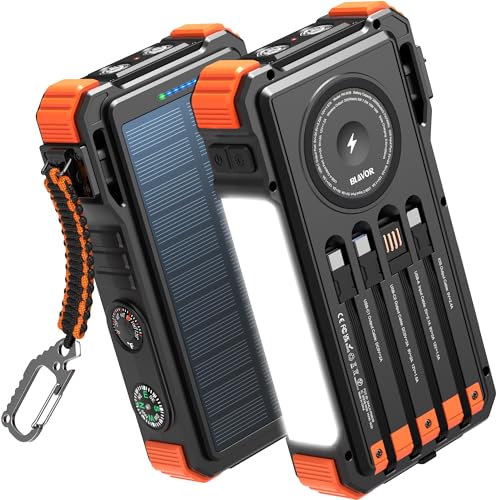
Selecting the right solar power bank in 2026 comes down to matching your specific needs with the right features. For those who need massive capacity and the ability to charge multiple devices wirelessly, the SOARAISE Solar Power Bank 48000mAh is an excellent choice for extended off-grid stays. Meanwhile, for hikers and backpackers who value extreme portability and a rugged build without sacrificing essential smart features, the BLAVOR Solar Power Bank 10,000mAh offers a compact, durable solution that blends function with fun. Whichever path you choose, investing in a quality solar power bank ensures you stay connected, safe, and powered up wherever your adventures take you.
Frequently Asked Questions
How long does it take to charge a solar power bank in sunlight?
Charging time varies greatly depending on the power bank’s capacity and the solar panel’s wattage. For example, a 10,000mAh bank with a 5W panel in direct sunlight might take 20 to 30 hours. Larger banks with multiple high-efficiency panels can reduce that time, but it’s still slower than using a wall charger. Solar charging is best for topping off or as an emergency backup.
Can I charge my laptop with a solar power bank?
Some high-capacity solar power banks with USB-C PD output (like those with 20W or higher) can charge many laptops, particularly ultrabooks and MacBooks, but not all. You need to check the power bank’s output wattage and your laptop’s charging requirements. For heavier laptops, a power station like the Jackery Explorer 300 is a more suitable option.
Are solar power banks waterproof?
Most solar power banks are not fully waterproof; they are typically water-resistant with ratings like IPX5 (can withstand water jets) or IP65 (dust-tight and protected against low-pressure water jets). They are designed to survive rain and splashes but should not be submerged. Always check the specific IP rating of the model you are considering.
What is the best solar power bank for camping in 2026?
The best solar power bank for camping depends on your trip length and power needs. For extended stays, a high-capacity model like the BLASOUL Solar Power Bank,49800mAh offers plenty of power for multiple devices. For shorter, lightweight trips, a portable and rugged option like the BLAVOR Solar Power Bank 20000mAh strikes a good balance. Consider our top laptop power banks for On-the-Go professionals for laptop-specific needs.