

You have a vision for capturing the city lights, starry skies, or moonlit landscapes. But when the sun goes down, your smartphone or entry-level camera struggles with noise and blur. That is where a mirrorless camera built for night photography comes in. In this guide, we evaluate six top mirrorless cameras that deliver sharp, low-noise images after dark. Whether you are a beginner on a budget or a seasoned pro, you will find a model that fits your needs. For more insights on specialized shooting, check out our guide to mirrorless cameras for wildlife photography.




Buying Guide: What to Look for in a Night Photography Mirrorless Camera
Sensor Size and Low-Light Sensitivity
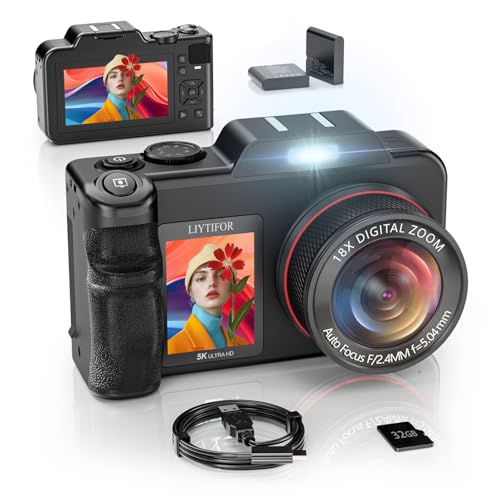
Larger sensors capture more light, reducing noise at high ISOs. Full-frame sensors (like those in the Canon EOS R6 Mark II and Canon EOS RP) excel in dim conditions. APS-C sensors (found in the Nikon Z50 II and Canon EOS R50) also perform well, especially with fast lenses. For budget options, the LIYTIFOR 5K and Duluvulu 4K use smaller sensors but include built-in fill lights to aid night shooting.
Image Stabilization
Handheld night shots demand stabilization. In-body image stabilization (IBIS) is a game-changer. The Canon EOS R6 Mark II offers up to 8 stops of shake correction, while the Canon EOS RP relies on lens-based stabilization. The Nikon Z50 II includes electronic VR for video. For static scenes, a tripod is still your best friend, but good stabilization lets you shoot handheld in twilight.
Autofocus Performance in Low Light
Fast, accurate autofocus is critical when light fades. The Canon EOS R50 and R6 Mark II use Dual Pixel CMOS AF II with down to -4 EV sensitivity. The Nikon Z50 II can detect and track subjects down to -4 EV as well. Budget cameras like the Duluvulu 4K offer basic autofocus with a fill light assist, but they may hunt in very dark conditions. For low-light autofocus reliability, prioritize models with phase-detection AF.
Lens Ecosystem and Fast Aperture Options
A camera is only as good as its lens. For night photography, you want lenses with wide apertures (f/1.8 or f/2.8) to let in more light. Canon’s RF mount offers excellent fast primes like the RF 50mm f/1.8 STM. Nikon’s Z mount also has bright lenses. The kit lenses included with the Canon EOS RP (RF24-105mm f/4-7.1) and Nikon Z50 II (16-50mm f/3.5-6.3) are versatile but not ideal for extreme low light. Consider adding a fast prime later. For more on lens choice, see our portrait photography camera guide which covers fast lenses.
Final Thoughts
After evaluating each model, we recommend the Canon EOS R6 Mark II Mirrorless Camera (Body Only) for serious night photographers who want full-frame performance, stellar stabilization, and reliable autofocus in the dark. For those on a tighter budget or just starting out, the Canon EOS RP Mirrorless Camera RF24-105mm Lens offers a full-frame sensor at a more accessible price point, making it a solid entry into low-light mirrorless photography. Both cameras will elevate your night shots significantly.
Frequently Asked Questions
What is the best mirrorless camera for night photography under $1000?
The Canon EOS R50 Mirrorless Camera with RF-S18-45mm lens is a strong choice under $1000. Its APS-C sensor and Dual Pixel CMOS AF II perform well in low light, and it supports fast lenses. The Nikon Z50 II with two lenses is another excellent option in this range.
Do I need a full-frame camera for night photography?
Not necessarily. APS-C cameras like the Nikon Z50 II can capture great night images, especially with a fast lens. Full-frame cameras (like the Canon EOS R6 Mark II) have an advantage in noise performance and dynamic range, but APS-C models are more portable and affordable. For landscape night shots, a full-frame may be worth the investment. Check our landscape photography camera guide for more details.
Can a budget mirrorless camera handle night photography?
Yes, budget models like the Duluvulu 4K Digital Camera and LIYTIFOR 5K have built-in fill lights and night scene modes that help. They are suitable for casual night shooting of static subjects. However, for better image quality and low-light autofocus, investing in a higher-end model like the Canon EOS RP is recommended.
What features matter most for night photography in 2026?
Key features include a large sensor (full-frame or APS-C), in-body image stabilization, a wide-aperture lens, and autofocus sensitivity down to -4 EV or lower. Also consider long-exposure noise reduction and bulb mode for star trails. For action night shots, high continuous shooting speeds help. See our sports photography guide for more on fast shooting.




