

You have a growing collection of classic ROMs from your childhood, but your main PC is too bulky or tied up with work. You need a dedicated machine that can handle emulation from NES to PlayStation Portable without breaking the bank or cluttering your desk. That is where the best mini PC for emulation comes in, and the Bmax Mini PC B1 Plus, Intel Celeron J3355 stands out as a compact and capable option. In this guide, we look at how this tiny desktop can power your retro gaming setup, covering its key features and performance for emulation enthusiasts. For more everyday computing needs, you might also explore our best mini PC for everyday use recommendations.

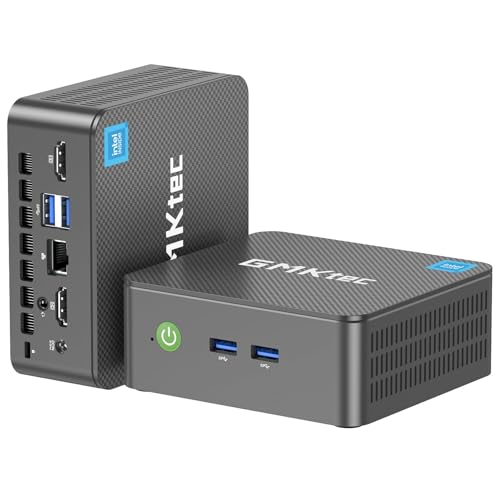


Buying Guide: What to Look for in a Mini PC for Emulation
Choosing the right mini PC for emulation requires more than just a low price. You need a balance of processing power, memory, storage, and connectivity to run a wide range of classic systems smoothly. Here are the key criteria we evaluate.
Processor Performance for Emulation Accuracy
The CPU is the heart of any emulation setup. Emulators translate old console instructions into modern code, which demands strong single-core performance. The Bmax Mini PC B1 Plus features an Intel Celeron J3355 processor that can boost up to 2.5 GHz. While not a gaming powerhouse, this chip handles 16-bit and 32-bit consoles like the Super Nintendo and PlayStation with ease. For more demanding systems like the Nintendo 64 or Dreamcast, the processor provides a solid baseline, though you may need to tweak settings for full speed.
Memory and Storage for Game Libraries
Emulation benefits from ample RAM to load game files and system assets quickly. With 6GB of LPDDR3 RAM, this mini PC offers enough headroom for multitasking and running emulators alongside front-end applications like RetroArch. Storage is equally important because ROM collections can grow large. The built-in 128GB eMMC is a good start, but the dual M.2 SSD slots (one SATA and one NVMe) allow expansion up to 2TB. This flexibility lets you keep your entire library on a fast SSD without replacing the original drive. If you need a machine for other tasks, our best mini PC for home server guide may also be useful.
Display Output and Graphics Capabilities
Retro games look fantastic on modern displays when upscaled, but you need a capable GPU and video outputs. The Intel HD Graphics 500 inside the Bmax B1 Plus supports 4K resolution at 60 Hz over dual HDMI ports. This means you can connect a high-resolution monitor or TV for a crisp, lag-free experience. The dual display support also allows you to keep a guide or playlist open on a second screen while gaming. For a theater-like experience, this mini PC handles 4K media playback smoothly, making it a versatile choice beyond emulation.
Connectivity and Expandability
Modern emulation setups often rely on wireless controllers, network access for game updates, and external storage. The Bmax Mini PC B1 Plus includes dual-band WiFi (2.4G and 5G) and Bluetooth 5.0 for connecting controllers and streaming. Gigabit Ethernet ensures stable online play for supported titles. The VESA mount lets you attach the PC behind a monitor, saving desk space. Additionally, the One-Click Restore feature via the F9 key simplifies system recovery if you experiment with different emulators or operating systems like Linux. For related hardware, check our best mini PC for Plex recommendations.
Final Thoughts
If you are building a dedicated emulation station on a budget, the Bmax Mini PC B1 Plus offers a compelling mix of compact size, expandable storage, and 4K output that brings retro games to life without overwhelming your desk or wallet. For those who need a more powerful option for demanding emulators like PlayStation 2 or Wii, consider the same model with upgraded storage to future-proof your setup. Whichever path you choose, this mini PC delivers a reliable foundation for countless hours of nostalgic gaming.
Frequently Asked Questions
Can the Bmax Mini PC B1 Plus run PlayStation 1 and Nintendo 64 emulators?
Yes, the Intel Celeron J3355 processor with 6GB RAM handles PS1 and N64 emulation smoothly at native resolutions. For best results, use optimized emulators like DuckStation for PS1 and Mupen64Plus for N64. You may need to adjust graphics settings for demanding games.
What emulators work best with the Intel HD Graphics 500?
Emulators like RetroArch, PCSX ReARMed, and Snes9x run well with the integrated GPU. For 2D games, you can enable shaders for a CRT effect. For 3D titles, keep the resolution at 720p or 1080p for smooth frame rates. The dual HDMI ports let you output to a TV for a console-like experience.
How do I expand storage for a large ROM collection?
The mini PC has two M.2 SSD slots: one SATA and one NVMe. You can add a 2TB NVMe drive for fast load times and keep the original 128GB eMMC for the operating system. This setup allows you to store thousands of ROMs without external drives. For a guide on organizing your library, see our best jump starter article for a different perspective.
Is this mini PC suitable for running demanding emulators like PS2 or Wii?
The Bmax B1 Plus can run lighter PS2 and Wii games at lower resolutions, but may struggle with more demanding titles. For optimal performance, stick to systems up to the Dreamcast era. If you need PS2 emulation, consider a mini PC with a faster processor like the Intel N100 or a Ryzen series. For more options, browse our Electronics category for other mini PCs.


