
🔥 TV Black Friday Deals 2026: picks worth watching →
You have just unboxed your first telescope, but the night sky looks like a scattered mess of dots. You want to see Saturn’s rings or the Orion Nebula, but without a guide, you feel lost. That is where Celestron telescopes shine, offering smart features that make stargazing accessible and rewarding. In this guide, we review the best Celestron telescope options for 2026, covering models for beginners, travelers, and serious astronomers. Whether you are a curious newcomer or an experienced observer, our evaluations will help you choose the right instrument for your needs. For a broader look at top telescopes, check out our best telescopes.




Buying Guide
Aperture: The Key to Light Gathering
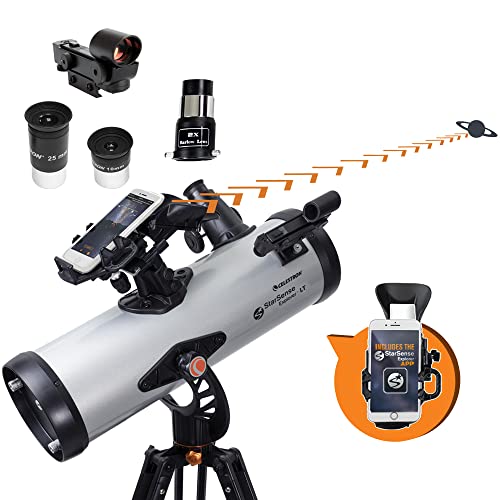
Aperture is the diameter of the main lens or mirror, and it determines how much light your telescope collects. Larger apertures reveal fainter objects and finer details. For planetary viewing, a 4.5-inch reflector like the Celestron StarSense Explorer LT 114AZ offers excellent clarity. For deep-sky objects, an 8-inch Schmidt-Cassegrain like the NexStar 8SE delivers stunning views of galaxies and nebulae.
Consider where you will observe: darker skies demand less aperture, but urban observers benefit from larger apertures to cut through light pollution. Beginners often start with 4 to 6 inches, while advanced users may choose 8 inches or more.
Mount Type: Manual vs. Computerized
The mount stabilizes your telescope and allows smooth tracking. Manual mounts, like the altazimuth on the Travel Scope 80mm, are lightweight and simple, perfect for quick setups. Computerized mounts, such as the GoTo system on the NexStar 8SE, automatically locate thousands of objects, saving you time and frustration.
If you value simplicity and portability, a manual mount works well. For precise tracking and automated tours, a computerized mount is a game-changer. Our outdoor gear reviews cover more mounting options for field use.
Portability and Setup
Telescopes range from compact travel kits to large observatory-style instruments. The Celestron Travel Scope 80mm kit includes a backpack and smartphone adapter, making it ideal for camping or trips. In contrast, the NexStar 8SE is heavier but still manageable for backyard sessions.
Think about how often you will move your telescope. Frequent travelers should prioritize lightweight, quick-assembly designs. Home observers can opt for larger, more stable setups.
Technology Features: StarSense and GoTo
Modern Celestron telescopes integrate smartphone apps and automated navigation. The StarSense Explorer series uses your phone’s camera to analyze star patterns and guide you to targets. The NexStar 8SE features a fully automated GoTo mount with SkyAlign, which aligns in minutes.
These technologies reduce the learning curve, especially for beginners. They also enhance the experience for seasoned users by saving time on manual star-hopping. For more on telescope tech, visit our telescopes and binoculars category.
Final Thoughts
After evaluating the top Celestron models, we recommend the Celestron StarSense Explorer LT 114AZ Newtonian for beginners who want a guided, app-powered experience without breaking the bank, and the Celestron NexStar 8SE Computerized Telescope for serious enthusiasts seeking automated deep-sky exploration with exceptional optics. Both deliver Celestron’s renowned quality and are backed by strong warranties, ensuring years of celestial discovery.
Frequently Asked Questions
What is the best Celestron telescope for beginners in 2026?
The Celestron StarSense Explorer LT 114AZ is ideal for beginners due to its smartphone-guided system, which eliminates the need for prior astronomy knowledge. Its 4.5-inch reflector provides clear views of the Moon and planets, and the setup is straightforward.
How does the StarSense technology work?
StarSense uses your smartphone’s camera to capture star patterns overhead. The app analyzes these patterns to determine the telescope’s exact position and then displays on-screen arrows to guide you to celestial objects. No Wi-Fi or GPS is required after initial alignment.
Can I use a Celestron telescope for astrophotography?
Yes, many Celestron models support astrophotography. The NexStar 8SE is a popular choice for imaging planets and deep-sky objects due to its large aperture and computerized tracking. For smartphone astrophotography, the Travel Scope 80mm kit includes a smartphone adapter for easy lunar and planetary shots.
What accessories come with Celestron telescopes?
Accessories vary by model. The Travel Scope 80mm kit includes a backpack, smartphone adapter, and two eyepieces. The StarSense Explorer LT 114AZ comes with two eyepieces and a finderscope. The NexStar 8SE includes a StarPointer finderscope and a 25mm eyepiece. Check the product page for full details.