You have just finished milling a stack of rough lumber for a custom dining table. But when you try to glue up the boards, gaps appear. Without a jointer, achieving perfectly flat faces and square edges is nearly impossible. Whether you are a seasoned cabinetmaker or a weekend DIYer, the right jointer transforms your workflow. In this guide, we have evaluated six of the best jointers for woodworking in 2026, from compact benchtop units to heavy-duty floor models. We considered cutterhead design, motor power, fence accuracy, and overall value. If you are new to woodworking, our guide to essential woodworking tools for beginners is a great place to start.


The table below summarizes the key specifications and ratings for each model. Use it to quickly compare features before diving into our buying advice.
Buying Guide: What to Look for in a Jointer
Cutterhead Type: Straight Knives vs. Spiral vs. Helical
The cutterhead is the heart of any jointer. Straight knife heads use two or three blades that require careful alignment and regular sharpening. Spiral and helical cutterheads use multiple small inserts, often carbide, that rotate into the cut. These produce a shearing action that reduces tearout and runs quieter. Spiral heads with two-sided or four-sided inserts offer long life and easy replacement. For example, the WEN JT833H 10-Amp 8-Inch Spiral Benchtop Jointer uses a spiral cutterhead with 16 staggered HSS blades for an ultra-fine finish, while the Cutech 40180HI 8-Inch Spiral Cutterhead Benchtop features a spiral head with tungsten carbide inserts that are two-sided for extended life. The JET 6-Inch Long Bed Jointer, Helical Cutterhead takes it further with a helical cutterhead and 27 four-sided indexable carbide inserts, offering the quietest and smoothest cut. For more on planing, check out our best wood planer for complementary tools.
Motor Power and Cutting Capacity
A jointer’s motor determines how aggressively it can remove material. Benchtop models typically offer 10 to 12 amps, enough for hardwoods at moderate depths. Larger floor models may have 1 to 2 HP motors. Also consider the cutterhead speed in RPM; higher speeds can yield smoother cuts. The Cutech 401100HI 10-Inch Spiral Cutterhead Benchtop boasts a 12-amp motor, giving it a 20% power boost over standard 10-amp models. Meanwhile, the WOODSTARTER 6-Inch Benchtop Jointer with 15 Amp packs a 15-amp motor, though it has a narrower cutting width. Variable speed models like the CRAFTSMAN Benchtop Jointer let you adjust RPM from 6,000 to 11,000 to match the material. For a complete workshop setup, explore our best woodworking tools for your home shop guide.
Fence Quality and Adjustability
The fence must remain square to the table and stay rigid under pressure. Look for a fence that tilts both left and right, with positive stops at common angles like 90° and 45°. A longer fence provides better support for longer workpieces. The Cutech models come with a 24-inch aluminum fence and patented enhancement brackets that stabilize both ends for flawless cuts. The CRAFTSMAN jointer uses a center-mounted fence that provides support throughout the cut. For bevel work, look for positive stops at 90° and 135°, as found on the WOODSTARTER and Cutech jointers. Accuracy in fence adjustment directly translates to square edges and consistent results.
Table Length and Build Quality
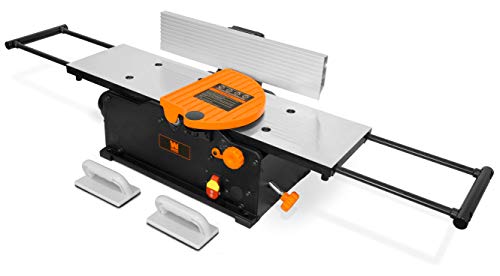
The combined length of the infeed and outfeed tables determines how well the jointer supports long boards. Longer tables reduce snipe and improve overall flatness. Cast iron tables offer stability and vibration damping, while aluminum tables are lighter. The WEN JT833H features a 33-inch table with support arms that extend to 51 inches, excellent for benchtop use. The JET 6-Inch Long Bed Jointer offers extra-long cast iron tables totaling 56 inches, minimizing snipe on long boards. Benchtop models typically have shorter tables but can handle most home shop projects with careful technique. For a full workshop upgrade, explore our best woodworking tools for every workshop guide.
Final Thoughts
Choosing the best jointer for woodworking depends on your space, budget, and the scale of your projects. For most home shop enthusiasts, the WEN JT833H 10-Amp 8-Inch Spiral Benchtop Jointer offers an outstanding balance of spiral cutterhead performance and benchtop convenience at a reasonable investment. If you need a professional-grade machine for heavy daily use, the JET 6-Inch Long Bed Jointer, Helical Cutterhead delivers industrial build quality and precision that will last a lifetime. Whichever you choose, a quality jointer will elevate every glue-up and joinery project.
Frequently Asked Questions
What is the best jointer for a beginner woodworker?
For beginners, a benchtop jointer like the WOODSTARTER 6-Inch Benchtop Jointer offers an affordable entry point with a powerful motor and simple setup. It is lightweight and easy to store. If you want a step up, the CRAFTSMAN Benchtop Jointer provides variable speed and a reliable fence. For more beginner-friendly tool recommendations, see our best woodworking tools for beginners guide.
Can a benchtop jointer handle hardwoods like oak or maple?
Yes, most benchtop jointers with 10-amp or higher motors can handle hardwoods when taking light passes. Models with spiral cutterheads reduce strain on the motor and produce cleaner cuts. For heavy-duty use, consider a floor model with a helical cutterhead. Always take shallow passes of 1/32 to 1/16 inch for best results. For a complete set of tools, check out our best woodworking tool set.
How often should I replace or rotate jointer blades?
It depends on usage. With carbide inserts, you can often rotate to a fresh edge multiple times before replacement. Straight HSS knives may need sharpening after several projects. A good rule is to inspect the finish quality: if you see tearout or burn marks, it is time to rotate or replace the blades. Spiral cutterheads with two-sided inserts offer double the life.
Do I need both a jointer and a planer?
While a jointer flattens one face and squares an edge, a planer thicknesses the opposite face to make boards parallel. For dimensioning lumber from rough stock, you need both tools. If you only buy one, a jointer is more versatile for edge jointing, but a planer is essential for consistent thickness. Many woodworkers start with a jointer and add a planer later.