You’ve decided to step up from your smartphone and buy a real camera. You want interchangeable lenses, excellent image quality, and a compact body that won’t weigh you down. That’s where a mirrorless camera shines. But with so many options on the market, finding the best mirrorless camera with lens can feel overwhelming. This guide is here to simplify that decision. We’ve evaluated top models from Canon, Nikon, and Sony to help you choose the one that fits your needs, whether you’re a beginner, an enthusiast, or a professional. If you’re just starting out, you might also want to check our guide on the best cameras for photography beginners.
In this article, we’ll break down the key features, pros, and cons of each camera, and provide a detailed buying guide. We’ll also answer some frequently asked questions to clear up any lingering doubts. By the end, you’ll have a clear idea of which mirrorless camera with lens is your perfect match.


Buying Guide: What to Look For in a Mirrorless Camera with Lens
Choosing the right mirrorless camera isn’t just about picking the most expensive model. It’s about matching the camera to your skill level, your shooting style, and your long-term goals. Let’s dive into the key factors you should consider.
Sensor Size and Resolution
The sensor is the heart of any camera. It determines image quality, low-light performance, and depth of field control. Mirrorless cameras typically come with either APS-C or full-frame sensors. APS-C sensors, like those in the Canon EOS R100 and Nikon Z50 II, offer a great balance of quality and affordability. They’re smaller and lighter, making the camera body more compact. Full-frame sensors, like the one in the Sony Alpha a7 IV, are larger and capture more light, resulting in better dynamic range and shallower depth of field. They’re ideal for professional work but come at a higher price.
Resolution also matters. A 24-megapixel sensor is more than enough for most users, even for large prints. Higher resolution, like the 33MP on the Sony a7 IV, gives you more cropping flexibility but also produces larger file sizes. Consider what you’ll be doing with your photos. If you’re sharing online and making standard prints, 24MP is plenty.
Lens Selection and Versatility
The lens is just as important as the camera body. A kit lens, like the 18-45mm or 16-50mm, is versatile for everyday shooting, covering wide-angle to standard focal lengths. Some bundles include a second telephoto zoom, like the 55-210mm or 50-250mm, giving you even more range for wildlife, sports, and portraits. When choosing a camera, consider the available lenses in that system. Canon’s RF mount and Sony’s E-mount have a wide range of lenses, from budget primes to high-end zooms. Nikon’s Z mount is also growing quickly.
Think about what you’ll be shooting. If you love landscapes, a wide-angle lens is essential. For portraits, a fast prime lens with a wide aperture (like f/1.8) will give you beautiful background blur. If you’re into travel, a compact all-in-one zoom might be more convenient. The beauty of a mirrorless system is that you can expand your lens collection over time.
Autofocus Performance
Autofocus (AF) has come a long way. Modern mirrorless cameras use phase-detection AF, which is fast and accurate. Look for features like eye detection and subject tracking. Canon’s Dual Pixel CMOS AF is renowned for its reliability, especially for tracking faces and eyes. The Nikon Z50 II can detect nine different subject types, including people, dogs, birds, and vehicles. Sony’s Real-time Eye AF is a favorite among portrait and wildlife photographers. If you plan to shoot action or moving subjects, a camera with robust AF is crucial. For more on cameras with excellent autofocus, check out our guide to cameras with Bluetooth.
Video Capabilities
If you’re planning to shoot video, pay attention to the camera’s video specs. Most modern mirrorless cameras shoot 4K, but the frame rate and quality can vary. The Canon EOS R50 shoots 4K at 30p, while the Nikon Z50 II offers 4K at 60p and 120p slow-motion in Full HD. The Sony a7 IV is a hybrid powerhouse, offering 4K at 60p with 10-bit color depth. Consider whether you need features like log profiles for color grading, or in-body image stabilization (IBIS) for handheld shooting. If vlogging is your thing, a flip screen is a must. We have a dedicated article on cameras with flip screens that you might find useful.
Final Thoughts
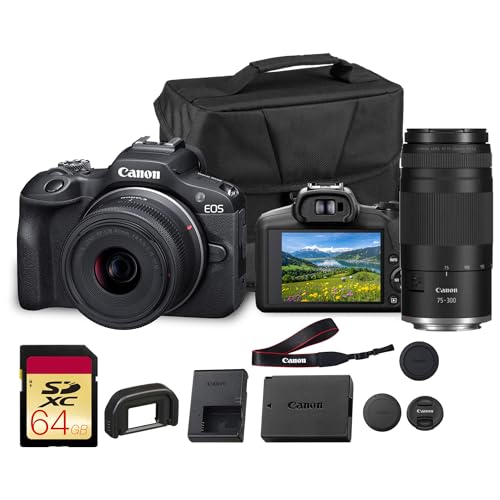
Choosing the best mirrorless camera with lens ultimately comes down to your personal needs and budget. For beginners and hobbyists who want a versatile, user-friendly kit, the Canon EOS R100 Mirrorless Camera with RF-S 18-45mm is an excellent entry point, offering great image quality and a simple interface. If you’re a creator who values advanced video features and a more robust autofocus system, the Nikon Z50 II with Two Lenses is a fantastic choice, giving you two lenses for added flexibility. No matter which you pick, you’re making a smart investment in your photography journey.
Frequently Asked Questions
What is the best mirrorless camera with lens for beginners?
For beginners, the Canon EOS R100 is a top pick. It’s compact, easy to use, and comes with a versatile 18-45mm lens. Its guided menu system and automatic scene modes help you learn the ropes without feeling overwhelmed. It’s a great first step into the world of interchangeable lens cameras.
Is a full-frame mirrorless camera worth the extra cost?
Full-frame cameras like the Sony Alpha a7 IV offer superior low-light performance, better dynamic range, and more control over depth of field. If you’re a professional or a serious enthusiast who needs the highest image quality, the investment is justified. However, APS-C cameras are more affordable and lighter, making them a better choice for travel and everyday carry.
Can I use my existing DSLR lenses on a mirrorless camera?
Yes, you can often use DSLR lenses on mirrorless cameras with an adapter. Canon, Nikon, and Sony all offer adapters that allow you to mount their DSLR lenses on their mirrorless bodies. This can save you money if you’re upgrading. However, autofocus speed and performance may vary depending on the lens and adapter.
What should I look for in a mirrorless camera for video?
For video, look for 4K resolution, a high frame rate (60p or higher), and good autofocus. Features like in-body image stabilization (IBIS) and a flip-out screen are also valuable. The Nikon Z50 II and Sony a7 IV are both excellent for video, offering 4K60 and 10-bit color. If you’re serious about filmmaking, you might want to explore our top cameras for videography.