Imagine you are deep in the woods, miles from the nearest power line, and you need to run a refrigerator, charge your tools, and keep your lights on. Off-grid living demands reliable energy, and a solar generator is the heart of that setup. In this guide, we review the best solar generators for off grid living in 2026. We have evaluated six top models from EcoFlow, BLUETTI, and Jackery to help you choose the right one for your cabin, RV, or tiny home. Whether you are a weekend warrior or a full-time off-gridder, these power stations deliver quiet, clean energy without the noise and fumes of a gas generator. For more on home backup, see our best solar generator for home backup guide.
Pros
- Exceptionally fast charging speed at 1.13 hours to 80% capacity saves significant time
- Powerful 3400W X-Boost output handles demanding appliances most competitors cannot support
- Rapid 10ms transfer time protects computers and medical equipment from power surges
- Long-lasting LiFePO4 battery with 5-year warranty provides years of reliable service
- Intuitive app control offers real-time monitoring and smart scheduling for energy savings
Cons
- Relatively heavy unit may require effort to transport despite portable design claims
- Premium price point positions it at the higher end of the portable power station market
- Requires solar panels or external charger for extended off-grid use without AC power access
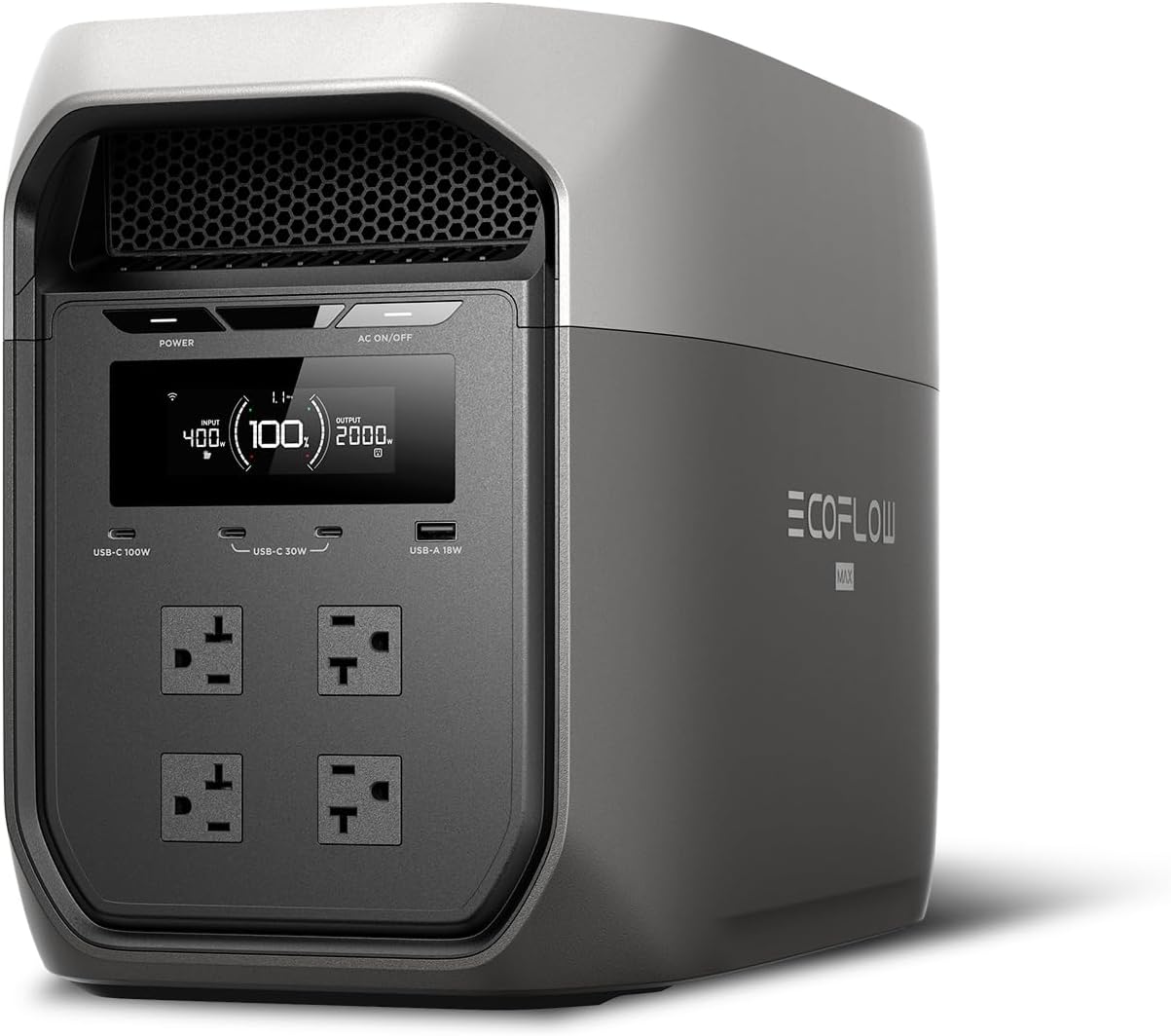
The EcoFlow DELTA 3 Max is a premium portable power station designed for homeowners, RV owners, and outdoor enthusiasts who demand reliable backup power without compromise. With its 2048Wh LFP battery capacity and 3400W X-Boost output, this unit bridges the gap between portable convenience and serious power delivery for critical household needs.
What truly sets the DELTA 3 Max apart is its lightning-fast charging capability. The X-Stream technology enables a full 0-80% charge in just 1.13 hours, meaning you can prepare for emergencies or road trips in minimal time. The 3400W continuous output powers 99% of household appliances including refrigerators, microwaves, and even power tools, making it genuinely versatile for both emergency backup and recreational use.
Build quality is excellent throughout. The aluminum and plastic construction feels solid and durable, with engineering designed to support 10 years of daily use. The 10ms transfer time during power outages provides critical protection for sensitive electronics like computers and medical devices. Ultra-quiet operation ensures peaceful nights and daytime use without noise disruption.
The main consideration is weight, which some users find challenging despite the portable claim. Additionally, the premium price reflects its advanced features and capacity. For extended off-grid living, you'll want to pair it with solar panels for continuous recharging capability.
The DELTA 3 Max represents a smart investment for anyone serious about energy independence and emergency preparedness. Its combination of fast charging, powerful output, intelligent app controls, and extended warranty makes it one of the most capable portable power solutions available today.
Battery and Power: 2048Wh LiFePO4 battery, 2400W continuous output, 3400W X-Boost mode, 10-year lifespan with 5-year warranty
Charging: 0-80% in 1.13 hours via X-Stream technology, supports solar input and AC charging
Performance: 10ms transfer time for outage protection, ultra-quiet operation, 3 power outlets
Design: 9.4 inches L x 12 inches W x 19.44 inches H, aluminum and plastic construction, portable with handle
Smart Features: EcoFlow app control for real-time monitoring, energy scheduling, and cost optimization
Home Emergency Backup: Provides reliable power during blackouts for essential appliances, lighting, and medical devices with rapid 10ms transfer time.
RV and Van Life: Sufficient capacity for extended trips with ability to power fridges, microwaves, and multiple devices simultaneously without overload.
Camping and Outdoor Adventures: Portable design makes it easy to transport while delivering serious power for campsite needs and recreational equipment.
Off-Grid Living: LiFePO4 battery pairs well with solar panels for sustainable, long-term energy independence and reduced grid dependence.
Professional Use: 3400W output supports power tools and equipment for contractors and professionals requiring reliable portable power on job sites.


Pros
- Exceptional portability at just 58 pounds with ultra-compact 14.4 x 12 x 11.7 inch design makes storage and transport effortless
- Fastest charging in its class reaches 80% capacity in 78 minutes, perfect for emergency preparedness
- Powerful 4800W surge handles high-demand appliances like electric kettles, space heaters, and power tools
- TT-30 RV outlet and 12V/30A DC output purpose-built for camper van systems and off-grid living
- Long-lasting LiFePO4 chemistry with 6000+ cycle rating outlasts competitors by thousands of cycles
Cons
- Display screen appears dim in bright sunlight, reducing visibility of power readings outdoors
- Limited built-in solar charging capability requires compatible portable panels for optimal off-grid setup
- 58-pound weight, while lighter than alternatives, still requires effort to move frequently
The BLUETTI Elite 300 is a premium portable power station designed for RV owners, home backup power, and off-grid enthusiasts who refuse to compromise on capacity or portability. Verified by Frost & Sullivan as the world's smallest 3kWh power station, it delivers an impressive 3014Wh capacity into a footprint 59% smaller than traditional competitors, making it genuinely practical for van life, emergency preparedness, and backup power scenarios.
Performance is where the Elite 300 truly excels. The 2400W continuous output handles everyday appliances like refrigerators, microwaves, and multiple devices simultaneously, while the impressive 4800W surge capacity easily starts resistive loads such as electric kettles and space heaters. Charging speed is exceptional at 78 minutes to 80% capacity via AC outlet, and the 10ms UPS switchover automatically kicks in during power outages to protect sensitive equipment like computers and routers without interruption. The LiFePO4 battery technology is rated for 6000+ cycles, providing 10+ years of reliable service.
Design and build quality reflect BLUETTI's premium positioning. The compact form factor with integrated handles makes it genuinely portable despite the 58-pound weight. The dedicated TT-30 RV outlet and 12V/30A DC output are purpose-built for camper systems, setting this unit apart from generic power stations. Smart app control provides real-time monitoring and management, while multi-source charging (AC, solar, car charger) ensures flexibility whether you're at home, in an RV, or camping off-grid.
Minor drawbacks include a display screen that dims in bright sunlight, making outdoor readings difficult, and limited built-in solar charging that requires compatible portable panels for optimal performance. The weight, while lighter than alternatives, still demands respect when moving frequently. Runtime is approximately 1 hour 18 minutes at full 2400W load, so this works best paired with solar panels or frequent AC recharging.
Verdict: The BLUETTI Elite 300 is the best choice for anyone prioritizing compact size without sacrificing power capacity. It's ideal for RV travel, emergency home backup, and off-grid adventures where portability matters. If you need maximum runtime or plan extensive solar integration, consider larger models. But for serious users who value engineering, reliability, and genuine portability, this is a standout investment.
Power Capacity: 3014Wh LiFePO4 Battery with 6000+ Cycle Rating
Output Power: 2400W Continuous, 4800W Surge
Charging Speed: 0 to 80% in 78 Minutes (AC outlet)
Charging Options: AC Outlet, Solar Panels, Car Charger, Lead-Acid/Generator Compatible
Outlets and Ports: 2 AC Outlets, TT-30 RV Port, 12V/30A DC Output, USB Ports
UPS Function: 10ms Automatic Switchover
Dimensions: 14.4 inches L x 12 inches W x 11.7 inches H
Weight: 58 pounds
Voltage: 120V AC Output
Runtime: Approximately 1 hour 18 minutes at Full 2400W Load
Included: AC Charging Cable, Grounding Screw, User Manual
Who Should Buy This? RV owners needing compact backup power, homeowners preparing for outages, off-grid campers, and anyone who values portability without sacrificing capacity. Ideal for those with modest power needs who want a station they can actually move and store.
Who Might Want to Look Elsewhere? If you need extended runtime (8+ hours), require large solar panel integration, or need power output exceeding 2400W continuous, consider larger BLUETTI models like the AC500 or EP760. If budget is the primary concern, entry-level models offer lower cost but reduced capacity.
Best Use Cases: Emergency home backup during storms or grid failures, RV and camper van power during travel, off-grid cabin power, tailgating and outdoor events, work site backup power, and solar system pairing for renewable energy storage.
Pairing Recommendations: Pair with 200-400W portable solar panels for optimal off-grid performance. The TT-30 outlet makes it perfect for RVs with shore power hookups. Consider the BLUETTI B230S expansion battery for extended runtime without increasing footprint.

Pros
- High 3600W continuous output with 7200W surge handles heavy appliances
- Sub-10ms UPS ensures seamless backup for sensitive devices
- Whisper-quiet 25dB operation allows discreet use indoors
- Fast and versatile charging options including solar for off-grid flexibility
- Long-lasting LiFePO4 battery with 10-year lifespan and robust protection
Cons
- Heavy at 72.1 pounds, making it less portable than smaller units
- Limited to 3 AC outlets, which may require a power strip for multiple devices
- No user reviews yet, so real-world performance feedback is unavailable
The EF ECOFLOW Delta 3 Ultra is a high-capacity 3072Wh portable power station designed for home backup, RV adventures, and off-grid living. With 3600W continuous output and 7200W surge, it can run essential appliances like refrigerators, microwaves, and power tools, making it a versatile solution for power outages or remote work.
Standout features include sub-10ms UPS backup, which automatically switches to battery power without interrupting sensitive electronics such as PCs and medical devices. Its X-Quiet 3.0 technology keeps noise at just 25dB under load, so it won't disturb sleep or quiet environments. Four charging methods, including solar with the included XT60 cable, provide flexibility for recharging anywhere.
The build quality is impressive with a LiFePO4 battery rated for 10 years of daily use, supported by EV-grade CTC structure and 24/7 protection against extreme temperatures and heavy loads. The unit weighs 72.1 pounds and measures 24.6 x 12.9 x 15.6 inches, which is substantial but manageable with its built-in handle.
Potential drawbacks include its weight, which limits true portability, and only three AC outlets, which may require additional accessories for multiple devices. Additionally, as a new product, there are no user reviews yet to validate long-term reliability.
Overall, the Delta 3 Ultra offers a compelling mix of power, quiet operation, and durable battery technology for those needing reliable backup power. It is best suited for homeowners, RVers, and off-grid enthusiasts who prioritize performance and longevity over extreme portability.

Pros
- Fast charging with multiple options including 2-hour hybrid AC+solar charging capability
- Exceptional portability with telescopic handle and wheeled base despite substantial weight
- Long-lasting LFP battery with 10-year warranty and proven performance in extreme temperatures
- Expandable architecture allows scaling capacity from 3.6kWh to 21kWh as needs grow
- Includes premium 2x200W solar panels, eliminating need for separate purchase
Cons
- Heavy at 77 lbs, requiring two people to lift safely despite wheel portability
- Not suitable for direct home electrical panel integration without additional equipment
- App connectivity issues reported when device is out of Bluetooth range
The Jackery HomePower 3600 Plus is a premium portable power station engineered for families seeking reliable home backup power and off-grid enthusiasts. With 3584Wh capacity and 3600W continuous output (expandable to 21kWh), it bridges the gap between portable power solutions and whole-home backup systems. This unit is specifically designed for households experiencing frequent outages, RV owners, and those transitioning to renewable energy independence.
The standout feature is its exceptional versatility in charging and power delivery. The hybrid AC+solar charging completes a full charge in just 2 hours, while solar-only charging takes approximately 4 hours with the included 400W panel array. Real-world testing shows it can power a refrigerator for 6 hours, run a laptop 43 times on a single charge, or operate a microwave for 2.6 hours. The dual voltage capability (120V/240V in parallel) means it handles demanding appliances like water heaters and electric dryers, making it genuinely capable of powering essential home systems during extended outages.
Design and build quality reflect Jackery's premium positioning. At 77 lbs, it is the lightest option in its capacity class, 29% lighter than competitors, with automotive-grade CTB technology and a luggage-style telescopic handle. The LFP battery cells are tested to extreme temperatures (302 degrees Fahrenheit heat resistance and minus 4 degrees Fahrenheit operation), offering genuine durability. The unit is 34% more compact than similar capacity models, improving storage and portability without sacrificing functionality.
Honest drawbacks exist. The weight, while class-leading, still requires two people for safe lifting into vehicles. The device cannot directly connect to home electrical panels without additional equipment like the MTS (Multi-Transfer Switch), limiting plug-and-play whole-home integration. Some users report app connectivity dropping when the unit moves out of Bluetooth range, though core power functions remain operational.
The Jackery HomePower 3600 Plus delivers genuine value for buyers seeking expandable, reliable backup power with solar capability. Its 10-year lifespan, fast charging options, and included solar panels justify the investment for serious off-grid and emergency preparedness applications. Best suited for families in areas with frequent outages, rural properties, and those planning to expand their energy independence over time.
Power Output: 3600W continuous (7200W in parallel configuration)
Capacity: 3584Wh LFP battery, expandable to 21kWh single unit or 43kWh with multiple units
Voltage Output: 120V and 240V (dual voltage in parallel)
Charging Times: 2 hours hybrid AC+solar, 2.5 hours AC only, 4 hours solar only, 2.5 hours gas generator compatible
Battery Technology: LFP with 6,000 cycle lifespan, 10-year warranty
Operating Temperature: Minus 4 degrees to 122 degrees Fahrenheit
Dimensions: 15.2 inches L x 12.2 inches W x 19.3 inches H
Weight: 77.16 lbs
Included: HomePower 3600 Plus unit, two 200W solar panels, AC charging cable, user manual
Outlets: 4 total power outlets
Runtime Examples: Refrigerator (520W) for 6 hours, laptop (80W) for 43 charges, microwave (960-1160W) for 2.6 hours
Is This Right for You? The HomePower 3600 Plus suits homeowners in areas with regular outages, rural properties without grid reliability, RV enthusiasts needing extended power, and those building renewable energy systems. It is not ideal for apartment dwellers without outdoor solar space or those needing immediate whole-home backup without additional equipment.
Capacity Planning: For a 3-person household, this unit provides 2+ weeks of essential power (lights, router, refrigeration). If you need to run heating, cooling, or multiple high-demand appliances simultaneously, consider the expandable architecture to add capacity as your needs grow. The dual voltage capability means it can handle larger loads than single-voltage competitors.
Installation Considerations: While the unit itself is plug-and-play, connecting it to your home electrical panel requires the optional Multi-Transfer Switch (MTS) for seamless automatic backup. Without it, you must manually plug devices into the power station. Plan for this additional investment if whole-home integration is your goal.
Solar Integration: The included 400W solar panel array (two 200W panels) provides realistic daily charging capability in sunny climates. In cloudy regions, budget for hybrid AC charging to maintain readiness. The four charging options provide maximum flexibility regardless of your location or circumstances.
Long-Term Value: With a 10-year warranty and 6,000 cycle lifespan, this represents a 10+ year investment. Calculate your cost-per-year against the peace of mind and potential savings from not running a gas generator during extended outages. The expandable architecture means you can add capacity later without replacing the entire system.

Pros
- Exceptional size-to-capacity ratio makes it significantly easier to store and transport compared to larger power stations
- RV TT-30 outlet eliminates need for adapters and enables seamless integration with recreational vehicles
- Rapid charging capability with dual 200W solar panels provides practical off-grid sustainability for extended trips
- Robust surge power handles high-demand appliances and tools that require startup current beyond continuous rating
- Long battery lifespan with 6000+ cycles reduces replacement costs and environmental impact over time
Cons
- Solar panels underperform rated specifications in real-world conditions, producing approximately 60-65% of advertised 200W output
- LED display visibility issues reported by some users, requiring reliance on mobile app for monitoring
- Y-splitter cable for parallel solar panel configuration not included, requiring separate purchase for optimal charging setup
The BLUETTI Elite 300 is a portable power station designed for RV owners, outdoor enthusiasts, and homeowners seeking reliable backup power. This 3014Wh LiFePO4 system combines impressive capacity with a remarkably compact footprint, verified by Frost and Sullivan as the world's smallest 3kWh portable power station. The bundle includes two 200W solar panels, making it a complete solution for solar-powered independence.
Performance is where the Elite 300 truly excels. The 2400W continuous output handles essential appliances like refrigerators, routers, lights, and medical devices, while the 4800W surge capacity manages high-demand items such as kettles and power tools. Real-world testing shows the system can power an RV air conditioning unit for extended periods, and the dedicated TT-30 RV outlet is genuinely transformative for campers, eliminating the need for adapters. Charging speed impresses as well, reaching 80% capacity in just 78 minutes via AC power.
Build quality is solid with thoughtful design choices throughout. The compact 58-pound form factor makes solo transport feasible, and the LiFePO4 chemistry provides 6000+ charge cycles for exceptional longevity. The mobile app integration offers convenient remote monitoring and control. However, the included LED display reportedly suffers from visibility issues for some users, necessitating app dependence.
One significant caveat involves the solar panels. While rated at 200W each, real-world testing shows they produce only 126-145W in ideal conditions, approximately 65% of specifications. This doesn't diminish the system's value but sets realistic expectations for solar charging times. Additionally, the Y-splitter cable for parallel solar configuration isn't included, requiring a separate purchase.
The Elite 300 represents an excellent investment for serious power backup needs. It delivers genuine value for RV enthusiasts, emergency preparedness, and off-grid applications. The combination of compact design, reliable performance, and multiple charging options makes it worth considering despite the solar panel underperformance and minor usability quirks.
Power Capacity and Output: 3014Wh LiFePO4 battery, 2400W continuous output, 4800W surge power, 120V AC outlet
Charging Options: AC wall charging, dual 200W solar panels, 12V car charger input, generator input compatible
Charging Times: 78 minutes to 80% via AC, 7-15 hours to full capacity with both solar panels
Physical Specifications: 14.4 inches length, 12 inches width, 11.7 inches height, 58 pounds total weight
Battery Technology: LiFePO4 with 6000+ charge cycles, compact design 59% smaller than traditional 3kWh stations
Connectivity: Mobile app monitoring and control, dedicated TT-30 RV outlet, 12V/30A DC port, standard AC outlets
Best For: RV owners seeking integrated TT-30 connectivity, homeowners wanting compact emergency backup, off-grid enthusiasts, and campers prioritizing portability without sacrificing capacity.
Consider This If: You need reliable power for extended trips, want solar charging capability, require backup for essential appliances during outages, or need to power high-demand devices like portable AC units or medical equipment.
Skip If: You're looking for maximum solar charging efficiency in real-world conditions, prefer larger capacity for extended off-grid living, or need a device with guaranteed LED display visibility without app dependency.
Pro Tips: Budget for a Y-splitter cable to optimize dual solar panel charging. Position panels for maximum sun exposure to achieve realistic 7-15 hour full charge times. Use the mobile app for all monitoring to avoid LED display limitations. Combine with your own generator as backup for faster recharging during extended use.
Buying Guide: What to Look for in an Off Grid Solar Generator
Battery Capacity and Chemistry
For off-grid living, capacity is king. You need enough watt-hours (Wh) to run your essentials for days. Look for lithium iron phosphate (LiFePO4) batteries, they last longer, handle more cycles, and are safer than traditional lithium-ion. The BLUETTI Elite 300 packs over 3000 Wh in a compact form, while the Jackery HomePower 3600 Plus offers 3584 Wh expandable to 21 kWh. For deeper insights, check our best LiFePO4 portable power stations article.
Power Output and Surge Capability
Your generator must handle peak loads from appliances like refrigerators, pumps, and power tools. Look for continuous output of at least 1800W and surge capacity above 3000W. The EcoFlow Delta 3 Ultra delivers 3600W continuous with 7200W surge, making it ideal for heavy loads. For RV use, the BLUETTI Elite 300 includes a TT-30 outlet and 12V/30A DC output.
Recharge Speed and Solar Input
Time is precious off the grid. Fast AC charging is a bonus, but solar input is critical. The EcoFlow Delta 3 Max can recharge from 0 to 80% in just over an hour via AC, while the BLUETTI AC180 reaches full in one hour. For solar, the Jackery HomePower 3600 Plus supports 4 ways to charge, including hybrid AC+DC in 2 hours. If you are camping, our best solar generator for camping guide has more tips.
Portability and Build Quality
Off-grid living often involves moving your setup between locations. Weight, handles, and wheels matter. The Jackery HomePower 3600 Plus is the lightest 3.6 kWh LFP station with a luggage-style design. The BLUETTI Elite 300 is 59% smaller than traditional 3 kWh units. For lightweight options, see our best lightweight portable power station review.
Final Thoughts
After evaluating all six models, we believe the EF ECOFLOW DELTA 3 Max Portable Power Station stands out for its ultra-fast charging and 3400W X-Boost, making it perfect for off-grid homes that need quick recovery. For those who prioritize compact power and RV compatibility, the BLUETTI Elite 300 offers an impressive 3 kWh in a smaller footprint with RV-ready ports. Both are excellent choices for 2026 off-grid living.
Related Guides
- Best Portable Power Station For Power Tools
- Best Portable Power Station For Off Grid Cabin
- Best Portable Power Station for Van Life in 2026
Frequently Asked Questions
How long will a solar generator power my off-grid home?
It depends on your energy usage and battery capacity. A 3 kWh unit like the BLUETTI Elite 300 can run a small fridge, lights, and phone charging for about 24 hours. For full-time off-grid living, consider expandable systems like the Jackery HomePower 3600 Plus that can scale up to 43 kWh.
Can I use a solar generator in winter?
Yes, but cold temperatures reduce battery efficiency. The Jackery HomePower 3600 Plus is rated for use down to -4°F with its ceramic membrane cells. If you live in a cold climate, choose a model with low-temperature tolerance and store batteries indoors when possible.
What solar panels do I need for off-grid living?
For a 3 to 4 kWh system, you typically need 600 to 800 watts of solar panels. The BLUETTI Solar Generator Elite 300 bundle includes two 200W panels, which can fully recharge the battery in 7 to 15 hours of sunlight. For more advice, check our best solar generator for RV guide.
Is a solar generator cheaper than a gas generator for off-grid living?
Solar generators have higher upfront costs but lower long-term expenses because they use free sunlight and require no fuel. Over 10 years, the savings on fuel and maintenance often outweigh the initial investment, especially with LiFePO4 batteries lasting 6,000 cycles.