You’re standing in a hardware store aisle, holding a tape measure that’s too short for the room you need to size up. Or you’re on a ladder, trying to hold the tape’s end against a ceiling corner while squinting at the measurement—and hoping you don’t drop your phone. We’ve all been there. That’s why the best laser distance measure has become an essential tool for DIYers and pros alike. Instead of wrestling with a flimsy tape, you can now point, click, and get an accurate reading in seconds—even over long distances. This guide breaks down the top laser distance measures of 2026, so you can find the perfect one for your projects.
Before we dive into the reviews, if you’re also into precision hand tools, you might want to check out our best ratcheting screwdriver guide for your toolbox. But for now, let’s measure up the best laser distance measures.
Top Laser Distance Measures: Our In-Depth Review
After evaluating dozens of models, we’ve narrowed down the top contenders. Here’s a quick comparison of the best laser distance measures on the market, followed by detailed reviews of each.




What to Look for in the Best Laser Distance Measure
Not all laser measures are created equal. To make the right choice, you need to consider a few key factors. Here’s what matters most when shopping for a laser distance measure.
Measurement Range and Accuracy
The first thing to check is how far the laser can measure and how precise it is. For most indoor DIY projects, a range of 30 to 50 feet is plenty. But if you’re measuring large outdoor spaces, you’ll want a model that can reach 100 feet or more. Accuracy is equally important—look for a tolerance of ±1/16 inch or better. This ensures your measurements are spot-on, whether you’re installing shelves or framing a wall.
Remember, the laser’s visibility also plays a role. Green-beam lasers are brighter and easier to see in daylight, making them ideal for outdoor use. Red-beam lasers are more affordable but can be hard to see in bright conditions. Consider where you’ll be using the device most often and choose accordingly.
Durability and Build Quality
A laser measure is an investment, so you want one that can handle the occasional drop or dusty job site. Look for models with an IP54 rating or higher, which means they’re protected against dust and water splashes. A rubberized housing or over-molded grip can also absorb shocks and provide a secure hold, even when your hands are sweaty or dirty.
Don’t forget to check the battery life. Most laser measures run on AAA batteries or have a built-in rechargeable battery. If you’re using it all day, a model with a long battery life or a quick-charge feature will save you from mid-project interruptions.
Ease of Use: Display, Buttons, and Modes
The best laser distance measure should be intuitive to operate. A backlit display with large, easy-to-read numbers is a must, especially if you’ll be working in dimly lit spaces. Look for a device with a simple button layout—you don’t want to fumble through menus when you’re on a ladder. A one-button measure function is ideal, but having quick access to area, volume, and continuous measurement modes is a bonus.
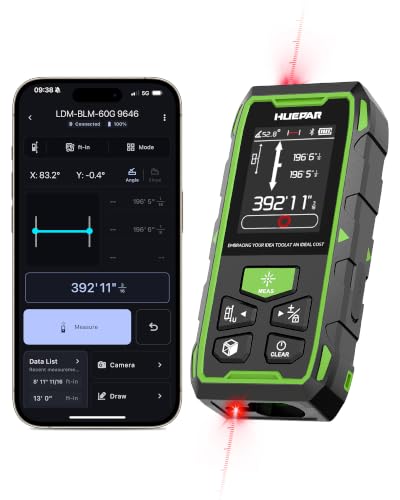
Some advanced models offer Bluetooth connectivity and a companion app that lets you store and share your measurements. This is a game-changer for professionals who need to create floor plans or send data to clients. However, if you just need a no-frills tool for occasional DIY, a basic model with a few modes will suffice.
Additional Features: Angle Sensor, P2P, and App Integration
If you’re willing to spend a little more, you can get a laser measure with advanced features that make your job even easier. An angle sensor, for example, lets you measure angles and calculate indirect height or width using the Pythagorean theorem. This is incredibly handy when you need to measure a wall’s height without a ladder.
Point-to-point (P2P) technology allows you to measure between two points without moving the device, which saves time on large projects. And if you’re tech-savvy, look for a model with app integration. With the right app, you can create digital floor plans, add annotations, and share your measurements with your team or client—all from your phone.
Final Thoughts
When it comes to choosing the best laser distance measure, the MILESEEY S50 Green Laser Distance Meter stands out for its exceptional green-beam visibility and advanced P2P technology, making it perfect for both indoor and outdoor use. For a more budget-friendly yet reliable option, the MILESEEY Laser Measure, 229ft Laser Measuring Tool offers solid accuracy and a range of practical modes at a great value. Whichever you choose, you’ll wonder how you ever got by without one.
Frequently Asked Questions
How accurate is a laser distance measure?
Most laser distance measures are accurate to within ±1/16 inch, which is much more precise than a standard tape measure. However, accuracy can be affected by factors like the reflectivity of the target surface and the distance. For best results, use a target plate or a light-colored surface when measuring over long distances.
Can I use a laser distance measure outdoors?
Yes, but you’ll need to consider the laser’s visibility. Green-beam lasers are brighter and more visible in daylight, making them a better choice for outdoor use. Red-beam lasers may be difficult to see in bright sunlight, so you might need to use a target or measure in the shade. Also, check the device’s range—some models have a shorter effective range outdoors due to ambient light interference.
Do I need a laser measure with an app?
It depends on your needs. If you’re a professional who needs to create detailed floor plans or share measurements with clients, an app-enabled laser measure can save you time and improve accuracy. Apps like Huepar’s allow you to sync data, add photos, and create project reports. For casual DIYers, a basic model without app connectivity is perfectly fine and often more affordable. For more insights on choosing the right tools, check our best laser level guide.
What’s the difference between a laser distance measure and a laser tape measure?
They’re essentially the same thing—both use a laser beam to measure distance. The term “laser tape measure” is often used for consumer-grade devices, while “laser distance measure” is a more professional term. However, some laser tape measures come with a physical tape for added versatility, but most standalone laser measures are more accurate and have a longer range.
For more tool recommendations, explore our guides on the best wire cutters and channel lock pliers to complete your toolkit.