You’re staring at a dead outlet, a car battery that won’t crank, or a flickering light fixture. You suspect a wiring issue or a blown fuse, but you have no way to confirm it. That’s where a multimeter steps in. It’s the one tool that lets you measure voltage, current, and resistance, turning guesswork into certainty. Whether you’re a DIY enthusiast, a student, or a homeowner tackling basic repairs, this guide will walk you through the best multimeters for beginners in 2026. We’ve evaluated four top contenders from AstroAI, Klein Tools, and LJPXHHU to help you make an informed choice. If you’re also looking to organize your workspace, check out our best tool box for every DIYer and mechanic.


Pros
- Lead-Alert protection reduces measurement errors and improves safety.
- Backlit display for easy reading in low light.
- Durable drop-proof design (6.6 ft) for job site reliability.
- Versatile testing functions including battery test.
- Affordable price for a trusted brand like Klein Tools.
Cons
- Manual-ranging requires user to select the correct range, which may be less convenient for beginners.
- No true RMS capability, limiting accuracy for non-sinusoidal waveforms.
- Limited to DC current only (10A), no AC current measurement.
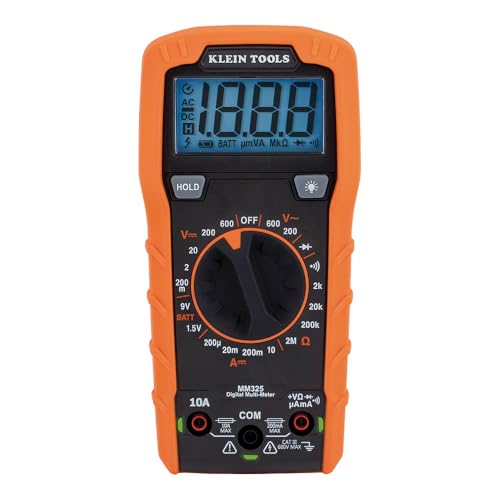
The Klein Tools MM325 is a manual-ranging digital multimeter designed for basic electrical troubleshooting in residential, commercial, and light-industrial settings. It targets DIY enthusiasts, homeowners, and electricians who need a reliable voltage tester without breaking the bank.
Standout features include the Lead-Alert system, which uses LEDs to indicate proper test lead placement, reducing the risk of incorrect connections. The backlit display ensures readability in dim environments, while the battery test mode adds everyday convenience for checking household batteries.
Build quality is robust, with a drop-test rating of 6.6 feet and a durable orange/black housing. The included test leads feature CAT III/CAT IV safety caps, and the meter offers test lead holders, a kickstand, and optional magnetic hanger for hands-free use.
One drawback is the manual-ranging operation, which requires users to select the correct range manually, potentially slowing down experienced users and confusing beginners. Additionally, it lacks true RMS capability, making it less accurate for measuring distorted waveforms.
Overall, the Klein Tools MM325 provides solid value for its price, combining essential functions, safety features, and ruggedness. It is a practical choice for anyone needing a dependable multimeter for basic electrical work.
Buying Guide
Accuracy and Resolution
For a beginner, accuracy is paramount. You want a meter that gives you reliable readings, whether you’re checking a 9V battery or a household outlet. Look for a higher count rating, such as 6000 counts, which offers better resolution than a basic 2000-count meter. True RMS capability is a bonus, as it ensures accurate measurements on non-linear loads like those found in modern electronics.
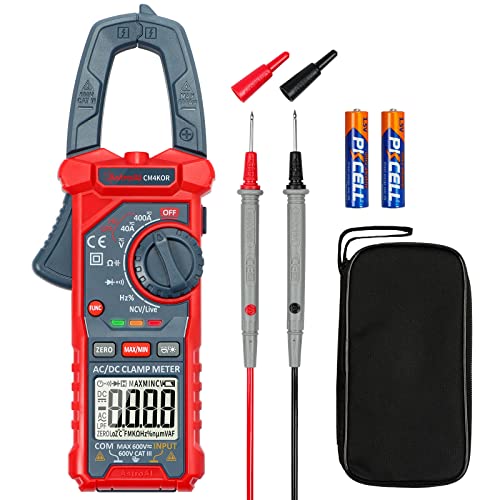
Consider the AstroAI Digital Multimeter, which boasts True RMS and 6000 counts. This level of precision is ideal for automotive and home troubleshooting, giving you confidence in every reading.
Safety Features
Safety should never be an afterthought. Look for multimeters with overload protection, fused current inputs, and safety-rated test leads. A meter with a sturdy, insulated casing and a built-in stand adds to both safety and convenience. The Klein Tools MM325, for instance, includes lead-alert LEDs that illuminate to confirm correct test lead placement, reducing the risk of error.
Always check that the meter meets relevant safety standards, and never use a meter that shows signs of damage. For more on organizing your tools safely, see our best portable tool box for 2026.
Ease of Use
As a beginner, you’ll want a multimeter that doesn’t intimidate. Features like auto-ranging, a backlit display, and data hold make measurements straightforward. A clear, large display is essential, especially in dimly lit areas. The Digital Multimeter Voltmeter Battery Voltage Multi from LJPXHHU offers a 2.7-inch backlit screen and a simple rotary dial, making it user-friendly.
Also, consider the physical design. A meter with a protective rubber cover and a fold-out stand can withstand drops and allows for hands-free operation, which is a boon when you’re working in tight spaces. If you’re building a home workshop, you might also want to read our top tool chests for a tidy garage.
Additional Functions
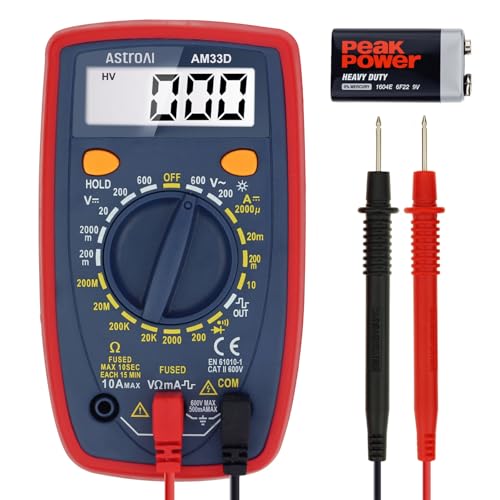
Beyond basic voltage and resistance, many multimeters offer extra functions like capacitance, frequency, and temperature measurement. These can be handy for specific tasks, such as checking capacitors in appliances or verifying thermocouples. The AstroAI Digital Multimeter Tester 2000 Counts includes a temperature probe, expanding its utility.
Think about what you’ll be working on. If you’re into automotive repair, a meter with a battery test mode, like the Klein Tools MM325, is a plus. For general household use, a basic meter with continuity and diode check suffices. For more on automotive tools, check out our automotive category.
Final Thoughts
Choosing the right multimeter as a beginner comes down to balancing accuracy, safety, and ease of use. For most DIYers and homeowners, the AstroAI Digital Multimeter offers a superb combination of True RMS accuracy and a wide range of functions at a reasonable cost. If you prefer a more budget-friendly option that still delivers reliable performance for basic tasks, the Digital Multimeter Voltmeter Battery Voltage Multi is a solid choice. Both meters will serve you well as you grow your skills, and they’re backed by reputable brands with responsive support.
Frequently Asked Questions
What is the difference between auto-ranging and manual-ranging multimeters?
Auto-ranging multimeters automatically select the correct measurement range, so you just set the function and read the display. Manual-ranging requires you to set the range yourself, which can be tricky if you don’t know the expected value. For beginners, auto-ranging is simpler and reduces the chance of errors.
Can a multimeter measure both AC and DC voltage?
Yes, most digital multimeters are designed to measure both alternating current (AC) and direct current (DC) voltage. You’ll need to select the appropriate mode, usually indicated by a V~ for AC and V⎓ for DC. This versatility makes them suitable for household outlets (AC) and batteries (DC).
How do I ensure my safety when using a multimeter?
Always start by reading the user manual. Check that the test leads are in good condition and properly inserted. Set the meter to the correct function and range before connecting to a circuit. Never touch the metal probes while the meter is connected to a live circuit. Use a meter with overload protection and safety-rated leads for added peace of mind.
What is the difference between a 2000-count and a 6000-count multimeter?
The count rating indicates the maximum reading the display can show. A 2000-count meter can display up to 1999, while a 6000-count meter can display up to 5999. Higher counts provide better resolution, especially for small voltage changes. For most hobbyist work, 2000 counts is fine, but for more precise measurements, a 6000-count meter is preferable.