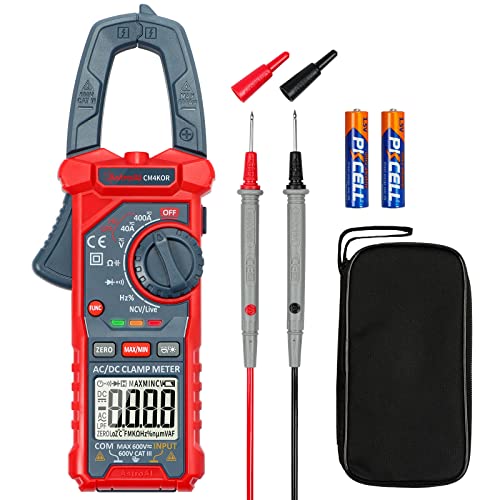
You’re on a job, and the outlet you’re checking is misbehaving. You need a reliable multimeter that gives you accurate readings every time, whether you’re a seasoned electrician or a dedicated DIYer. The wrong tool can lead to wasted hours and safety risks. That’s why we’ve reviewed the top multimeters for electricians to help you choose the right one for your toolbox.
In this guide, we’ll break down the key features that matter most for electrical work, compare three standout models from AstroAI, Klein Tools, and KAIWEETS, and share our recommendations for different needs. If you’re also looking for other essential tools, check out our guide to the best wire strippers for a complete professional setup.


Pros
- Lead-Alert protection reduces measurement errors and improves safety.
- Backlit display for easy reading in low light.
- Durable drop-proof design (6.6 ft) for job site reliability.
- Versatile testing functions including battery test.
- Affordable price for a trusted brand like Klein Tools.
Cons
- Manual-ranging requires user to select the correct range, which may be less convenient for beginners.
- No true RMS capability, limiting accuracy for non-sinusoidal waveforms.
- Limited to DC current only (10A), no AC current measurement.
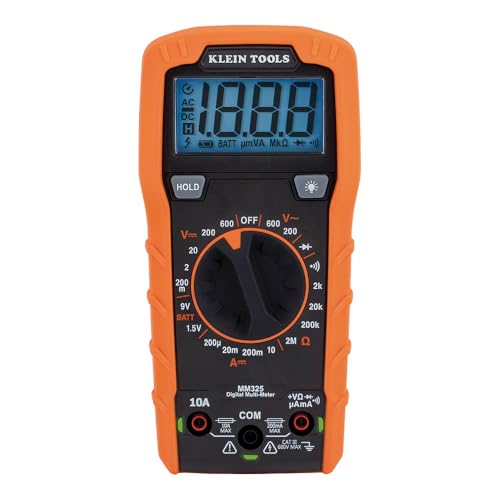
The Klein Tools MM325 is a manual-ranging digital multimeter designed for basic electrical troubleshooting in residential, commercial, and light-industrial settings. It targets DIY enthusiasts, homeowners, and electricians who need a reliable voltage tester without breaking the bank.
Standout features include the Lead-Alert system, which uses LEDs to indicate proper test lead placement, reducing the risk of incorrect connections. The backlit display ensures readability in dim environments, while the battery test mode adds everyday convenience for checking household batteries.
Build quality is robust, with a drop-test rating of 6.6 feet and a durable orange/black housing. The included test leads feature CAT III/CAT IV safety caps, and the meter offers test lead holders, a kickstand, and optional magnetic hanger for hands-free use.
One drawback is the manual-ranging operation, which requires users to select the correct range manually, potentially slowing down experienced users and confusing beginners. Additionally, it lacks true RMS capability, making it less accurate for measuring distorted waveforms.
Overall, the Klein Tools MM325 provides solid value for its price, combining essential functions, safety features, and ruggedness. It is a practical choice for anyone needing a dependable multimeter for basic electrical work.
Buying Guide: What to Look for in a Multimeter for Electricians
Choosing the right multimeter goes beyond just picking the first one you see. For electricians, accuracy, safety, and durability are non-negotiable. Here are the essential criteria to consider before making your purchase.
Accuracy and True RMS
Accuracy is the foundation of any multimeter. For electricians, a True RMS (Root Mean Square) multimeter is crucial because it provides accurate readings on both sine waves and non-sine waves, which are common in modern electrical systems. Look for a unit with a high count rating, such as 6000 counts, for more precise measurements.
Without True RMS, you might get misleading values when dealing with variable frequency drives or other non-linear loads. This can lead to incorrect diagnostics and wasted time. Always prioritize a multimeter that offers True RMS for professional-grade reliability.
Safety Features and CAT Ratings
Safety is paramount when working with electricity. A multimeter should have a high CAT rating, such as CAT III or CAT IV, which indicates it’s designed to handle transient voltage spikes in different environments. Look for features like overload protection, fused current inputs, and insulated test leads.
Some models, like the Klein Tools MM325, offer lead-alert protection that warns you if the leads are placed incorrectly. This reduces the risk of damage to the meter and, more importantly, protects you. Always verify that the multimeter meets current safety standards before use.
Durability and Build Quality
Electricians work in demanding environments, so a multimeter must withstand drops, impacts, and rough handling. Look for models with a rugged casing, often made of rubber or reinforced plastic, and a design that can survive a fall from a ladder or workbench. A built-in kickstand and magnetic hanger can also add convenience.
Durability also extends to the test leads. High-quality leads with reinforced connectors and flexible cables are less likely to break or fray. A meter that lasts through years of daily use is a better investment than one that needs frequent replacement.
Ease of Use and Additional Functions
A multimeter should be intuitive to operate, especially when you’re in a tight spot. Features like a backlit display, data hold, and auto-ranging make measurements easier and reduce the chance of errors. For electricians, additional functions like capacitance, frequency, and temperature measurement can be valuable for troubleshooting various systems.
Some kits, such as the KAIWEETS Electrical Test Kit, include a non-contact voltage detector and a GFCI outlet tester, providing a comprehensive solution for electrical work. Think about the types of tasks you perform most often and choose a multimeter that covers those needs without unnecessary complexity.
Final Thoughts
When it comes to the best multimeter for electricians, our top picks cater to different needs: the AstroAI Digital Multimeter offers a perfect balance of advanced features and affordability for general electrical troubleshooting, while the KAIWEETS Electrical Test Kit KIT01 is ideal for professionals who want a complete set of tools in one convenient case, including a non-contact voltage pen and GFCI tester. Both are reliable choices that will serve you well in any electrical project.
Frequently Asked Questions
What is the difference between a manual-ranging and auto-ranging multimeter?
A manual-ranging multimeter requires you to select the measurement range before taking a reading, which can be tedious and prone to error if you guess wrong. An auto-ranging multimeter automatically selects the correct range, making it faster and easier to use, especially for beginners. For electricians, auto-ranging is often preferred for its convenience and accuracy.
Can a multimeter measure both AC and DC voltage?
Yes, most multimeters designed for electricians can measure both AC and DC voltage. This is essential because residential and commercial electrical systems use AC, while batteries and many electronic devices use DC. Ensure the multimeter you choose has a wide voltage range, such as up to 600V, to handle various applications.
What safety precautions should I take when using a multimeter?
Always start by reading the manual and understanding the meter’s ratings. Use the correct input jacks and select the appropriate function and range before connecting to a live circuit. Never exceed the maximum voltage or current ratings, and use insulated test leads. Additionally, ensure the multimeter has a CAT rating suitable for the environment you’re working in.
Is it worth buying a multimeter kit with extra tools?
If you’re a professional electrician or a serious DIYer, a kit like the KAIWEETS Electrical Test Kit can be a great investment because it provides a multimeter, a non-contact voltage tester, and a GFCI outlet tester in one package. This saves you from buying separate tools and ensures you have everything you need for most electrical tasks. For simple jobs, a standalone multimeter might be sufficient, but the kit offers more versatility.