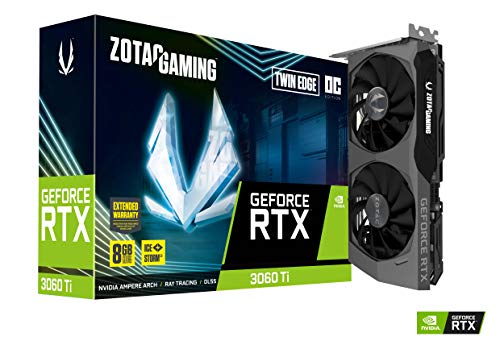
Ray tracing transforms gaming with lifelike lighting and shadows, but picking the right graphics card can be daunting. Whether you are building a new rig or upgrading for immersive titles, the best ray tracing graphics cards in 2026 deliver stunning visuals without breaking your budget. This guide reviews five top models from ASUS, ASRock, and GIGABYTE, covering everything from entry-level to high-end performance.
If you are looking for a broader selection of high-performance GPUs, check out our roundup of the best graphics cards with 8GB VRAM for additional options that excel in ray-traced games.


Buying Guide: What to Look for in a Ray Tracing GPU
Ray Tracing Performance and Cores
Ray tracing relies on dedicated hardware cores (RT Cores on NVIDIA or Ray Accelerators on AMD and Intel) to calculate light paths in real time. Cards with newer generation cores, such as the 3rd gen RT cores in the ASUS Dual GeForce RTX 3050 or the 3rd gen Ray Accelerators in ASRock Radeon RX 9070, provide higher throughput and better efficiency. For smooth ray tracing at 1440p or 4K, look for a high core count and support for technologies like DLSS or XeSS to boost frame rates.
VRAM Capacity and Memory Bandwidth
Ray tracing demands extra video memory for texture data and lighting buffers. A card with at least 8GB of GDDR6, like the ASRock Radeon RX 7600 Challenger Pro, handles 1080p and 1440p comfortably, while 12GB or 16GB models (e.g., ASRock Intel Arc B580 or GIGABYTE Radeon RX 9070 XT) are better suited for 4K textures and future titles. Higher memory bandwidth (measured in GB/s) also reduces stuttering in complex scenes. For more on memory requirements, explore the Cards category for detailed guides.
Cooling System and Noise Levels
Ray tracing generates significant heat, so efficient cooling is crucial for sustained performance. Many cards in this lineup feature dual- or triple-fan designs with 0dB Silent technology, such as the ASRock Arc B580 and RX 7600 models, which stop fans entirely under low loads for silent operation. For overclocked cards like the GIGABYTE RX 9070 XT, the WINDFORCE cooling system with Hawk fans keeps thermals in check. If you prioritize silent builds, look for models with large heatsinks and multiple heatpipes.
Connectivity and Power Requirements
Modern ray tracing GPUs often require PCIe 4.0 or 5.0 support for maximum bandwidth. All cards here support at least PCIe 4.0, with the ASRock RX 9070 utilizing PCIe 5.0 for future-proofing. Power supply requirements vary: entry-level cards like the ASUS RTX 3050 need a modest 550W unit, while high-end options demand 700W or more. Always check chassis clearance for card length, especially with triple-fan models. For additional recommendations on PC audio to complement your gaming setup, see our best home theater sound cards list.
Final Thoughts
After evaluating the latest ray tracing graphics cards, we find that the ASRock Intel Arc B580 Challenger 12GB OC Graphics offers exceptional value for 1440p ray tracing with its XeSS 2 upscaling and silent dual-fan cooling, while the GIGABYTE Radeon RX 9070 XT Gaming OC 16G Graphics delivers top-tier performance for enthusiasts who want to max out ray tracing at 4K with its powerful WINDFORCE cooler and 16GB VRAM. Whether you are on a budget or aiming for the best, these two picks cover the spectrum of needs for immersive ray-traced gaming in 2026.
Frequently Asked Questions
What is ray tracing and why do I need a special graphics card?
Ray tracing simulates the physical behavior of light to create realistic reflections, shadows, and global illumination in games. Dedicated hardware cores in modern GPUs accelerate these calculations, so a card with ray tracing capabilities is essential for smooth performance. Without them, games rely on software approximations that are less accurate and more demanding on the CPU.
How much VRAM do I need for ray tracing in 2026?
For 1080p ray tracing, 8GB of VRAM is sufficient for most titles. At 1440p, we recommend 12GB or more, while 4K gaming with ray tracing benefits from 16GB. Cards like the ASRock RX 9070 with 16GB provide headroom for high-resolution textures and future games. If you are unsure, check our best graphics cards with 8GB VRAM guide for options that balance cost and performance.
Is DLSS or XeSS important for ray tracing performance?
Yes, upscaling technologies like NVIDIA DLSS and Intel XeSS use AI to render frames at a lower resolution and then upscale them, significantly boosting frame rates in ray-traced games. The ASUS RTX 3050 supports DLSS, while the ASRock Arc B580 features XeSS 2. Both preserve image quality while making ray tracing more playable on mid-range hardware.
Can I use a ray tracing graphics card for non-gaming tasks?
Absolutely. Ray tracing GPUs excel in professional workflows like 3D rendering, video editing, and AI applications. The dedicated RT and Tensor cores (or similar) accelerate tasks in Blender, DaVinci Resolve, and machine learning. Cards with large VRAM, such as the 16GB GIGABYTE RX 9070 XT, are especially valuable for creative projects in 2026.