

You’ve been capturing memories with your phone, but now you crave more creative control, better image quality, and the ability to swap lenses. Canon’s mirrorless cameras offer an easy transition with intuitive controls, compact bodies, and outstanding results. Whether you’re documenting family life, starting a vlog, or exploring photography as a hobby, there’s a Canon mirrorless body that fits your needs and budget. In this guide, we’ve reviewed the best Canon mirrorless cameras for beginners in 2026, comparing features, performance, and value to help you make a confident choice. If you’re also curious about image stabilization, check out our guide on best mirrorless cameras with image stabilization for additional insights.
Compare the Best Canon Mirrorless Cameras for Beginners



Buying Guide: What to Look for in a Beginner Canon Mirrorless Camera
Sensor and Image Quality
All the cameras in this roundup feature APS-C sensors, which offer a great balance of image quality and portability. The Canon EOS R100 and R50 use a 24.1MP sensor with DIGIC 8 processor, while the R10 upgrades to DIGIC X for faster performance and improved noise handling. For beginners, any of these sensors deliver vibrant colors and sharp details that far exceed smartphone cameras. If low-light performance is a priority, you might also want to read our best mirrorless cameras for low light article.
Autofocus and Speed
Canon’s Dual Pixel CMOS AF is a standout feature for beginners. It provides fast, accurate autofocus with face and eye detection, making it easy to keep subjects sharp whether you’re shooting photos or video. The R10 offers the most advanced AF with subject tracking for people, pets, and vehicles, plus burst shooting up to 23fps. The R100 and R50 are also very capable, with reliable tracking that inspires confidence.
Video Capabilities
If you plan to create video content, consider the 4K recording options. The Canon EOS R50 and R10 oversample 4K for extra detail, while the R100 records 4K at 24fps with a crop. All models offer Full HD at 60fps and slow-motion HD at 120fps. The R50 also includes vertical video support and Creative Assist, making it especially beginner-friendly for social media creators.
Lens Compatibility and Expandability
All these cameras use Canon’s RF mount, giving you access to a growing lineup of RF and RF-S lenses. The included kit lenses (18-45mm, and sometimes a telephoto zoom) cover a wide range of everyday scenarios. As you progress, you can add lenses like the RF 50mm f/1.8 for portraits or the RF 24-105mm for travel. The R10 offers the most room to grow with its advanced features and compatibility with Canon’s full-frame RF lenses.
Final Thoughts
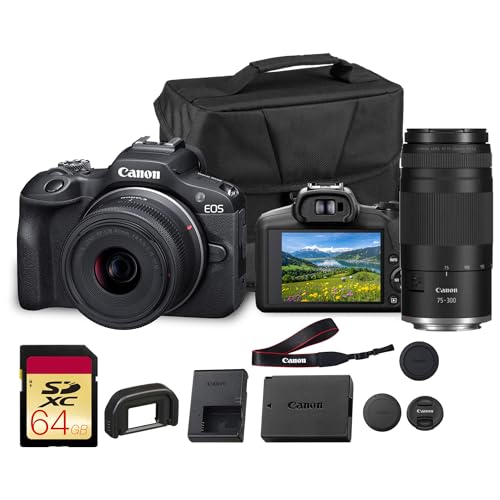
After evaluating all seven Canon mirrorless cameras, we believe the best choice for most beginners is the Canon EOS R100 Mirrorless Camera + 2 Lens Kit for its unbeatable value and dual-lens versatility, covering everything from everyday snapshots to distant subjects. If you’re willing to invest a bit more for faster autofocus, higher burst rates, and oversampled 4K video, the Canon EOS R10 Mirrorless Camera with 18-45mm Lens is a fantastic step up that will serve you well as your skills grow. Whichever you choose, you’re getting a reliable, beginner-friendly camera that will help you capture beautiful memories for years to come.
Frequently Asked Questions
Which Canon mirrorless camera is best for a complete beginner?
The Canon EOS R100 is the most affordable and easiest to use, making it ideal for those new to interchangeable-lens cameras. Its simple menu system, auto modes, and compact design help you learn without feeling overwhelmed. For a small upgrade in features, the Canon EOS R50 adds vertical video and Creative Assist, perfect for vloggers.
Can I use Canon DSLR lenses on these mirrorless cameras?
Yes, you can use Canon EF and EF-S DSLR lenses with an optional Mount Adapter EF-EOS R. This allows you to leverage existing glass while transitioning to mirrorless. Autofocus and image stabilization continue to work, though performance may vary with older lenses.
Do Canon mirrorless cameras have good autofocus for video?
Absolutely. Canon’s Dual Pixel CMOS AF provides smooth, reliable autofocus during video recording, with face and eye detection that keeps subjects sharp. The R10 and R50 offer the most advanced tracking, but even the R100 delivers solid results for casual vlogging and home videos.
What is the difference between the Canon R50 and R10?
The R10 is a step up from the R50, offering a faster DIGIC X processor, higher burst rates (23fps vs 15fps), and more advanced subject tracking for animals and vehicles. The R50 is lighter and includes dedicated vlogging features like vertical video. Both shoot oversampled 4K, but the R10 has a deeper feature set for growing photographers.




