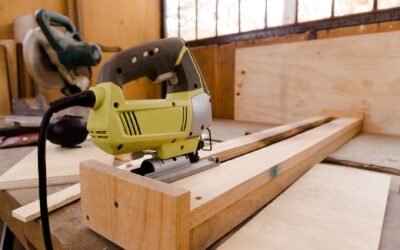
A jigsaw and circular saw serve different cutting purposes, and the right choice depends entirely on your project. Jigsaws excel at curved, intricate cuts and detail work, while circular saws are built for fast, straight cuts through thick materials. Understanding what each tool does best will save you time and frustration on your next project.

Straight Cuts vs. Curved Cuts
Circular saws are designed for speed and power on straight cuts. The spinning blade moves in one direction, making it ideal for ripping boards lengthwise or crosscutting lumber quickly. You’ll get clean, fast results on long, straight lines with minimal effort.
Jigsaws handle curves, angles, and intricate shapes that a circular saw cannot. The up-and-down blade motion lets you follow a pencil line around corners, through tight spaces, and along complex patterns. If your project involves any curved cutting, a jigsaw is your only practical option.
Material Thickness and Density
Circular saws excel at cutting through thick, dense materials like solid wood, plywood, and lumber. Their powerful motors and large blades push through material quickly without bogging down, making them the standard for framing and deck work.
Jigsaws work best on thinner materials and softer woods. While they can cut through thicker stock, they do so more slowly and require more operator control to stay on line. For thin plywood, veneer, or delicate materials, a jigsaw gives you better precision and less risk of tear-out.
Precision and Detail Work
If your project demands accuracy around tight corners or along detailed patterns, a jigsaw wins. The blade is narrow and the cutting motion is controlled, so you can follow a line closely and make adjustments as you go.
Circular saws sacrifice precision for speed. The blade is wider, and the tool’s design makes it harder to follow a winding line or stop exactly where you want. For rough framing or quick cuts where perfection isn’t critical, that’s not a problem.
Portability and Setup
Jigsaws are lighter and more compact, making them easier to handle and store. You can use one one-handed in many situations, and they take up minimal space in a workshop or truck.
Circular saws are heavier and require two hands for safe operation. They also often need a work surface or guide system to cut straight, which means more setup time. For stationary work, that’s manageable; for mobile projects, it adds friction.
Speed and Production Volume
When you need to make many straight cuts quickly, a circular saw is faster. Its motor power and blade size mean less time per cut, which adds up over a large project.
Jigsaws are slower by design. The up-and-down blade motion and the need to guide the tool carefully along a line mean each cut takes longer. If you’re making dozens of identical cuts, a circular saw saves hours.
Cost and Complexity
Both tools are affordable, but circular saws tend to be simpler mechanically and often cost less. A basic model will handle most straight-cutting jobs without bells and whistles.
Jigsaws come in many varieties with different features like orbital action, variable speed, and bevel cuts. Entry-level models are inexpensive, but advanced versions can cost more if you need specialized capabilities.
How to Choose the Right Tool for Your Project
- Use a circular saw if your project involves primarily straight cuts, thick lumber, or high volume work.
- Use a jigsaw if you need curved cuts, detail work, or precise cuts on thinner materials.
- Consider buying both if you do varied woodworking, since they handle different jobs and aren’t interchangeable.
- Start with the tool that matches your most common project type, then add the other as your skills grow.
If you’re planning woodworking projects that combine both straight and curved cuts, you’ll likely benefit from understanding how to use each tool safely and effectively. A cordless drill for woodworking is another essential tool that pairs well with either saw for a complete workshop setup.
Frequently Asked Questions
Can a jigsaw make straight cuts?
Yes, but it’s slower and less accurate than a circular saw. A jigsaw can cut straight if you use a guide or clamp a straightedge, but it’s not the tool’s strength. For straight cuts, a circular saw is always the better choice.
Can a circular saw cut curves?
No, not practically. A circular saw’s large, wide blade cannot follow a curved line. Attempting sharp curves or tight angles will either break the blade or produce a jagged, dangerous cut. Use a jigsaw for any curved work.
Which saw is safer for beginners?
A jigsaw is generally safer for beginners because it’s lighter, easier to control, and cuts slower. A circular saw is more powerful and requires more respect for kickback and blade guard awareness, making it riskier if you’re still learning.
Do I need both saws, or can I get by with one?
If you only do basic home projects with straight cuts, a circular saw is enough. If you tackle varied projects including shelving, trim work, or decorative pieces, both tools earn their space. One tool cannot reliably replace the other.
What’s the learning curve for each tool?
A jigsaw is intuitive; most people can make decent cuts within minutes. A circular saw requires practice to control kickback, maintain a straight line, and handle its power safely. Budget more practice time with a circular saw before tackling critical cuts.
Related Guides
The Bottom Line
Jigsaw vs circular saw isn’t a question of which is better, but which is right for your specific cut. Match the tool to the job: circular saw for straight cuts and speed, jigsaw for curves and precision. Understanding both will make you a more capable and confident woodworker.