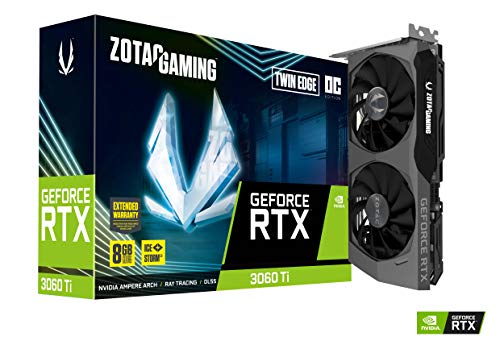
If you juggle spreadsheets, watch live stock tickers, or manage multiple applications at once, a single screen often falls short. Adding three extra displays can transform your workflow, but only if your graphics card has enough ports and power to drive them all. The challenge is finding a GPU that delivers stable, simultaneous output to four monitors without breaking your budget. This guide covers the top graphics cards for four monitors available in 2026, from compact low-profile models to cards with native quad HDMI outputs.
Whether you are building a trading workstation, a security camera hub, or a home theater PC, the right video card makes all the difference. We evaluated each product for port variety, resolution support, ease of installation, and long-term reliability. For more tips on multi-monitor setups, check out our guide to graphics cards for multiple monitors.



Buying Guide: What to Look for in a Quad Monitor Graphics Card
Number and Type of Display Outputs
For a true four monitor setup, the card must have at least four independent outputs. HDMI ports are common and convenient for connecting modern monitors and TVs, while DisplayPort (DP) offers higher bandwidth for larger resolutions. Some cards mix HDMI, DP, and even VGA or DVI to accommodate older displays. Check which ports your monitors use and consider adapters if needed.
If all four monitors share the same connection type, a card with four identical ports simplifies cabling. For example, the Xynsviu RX560 provides four HDMI ports, making it a straightforward choice for HDMI‑based setups. On the other hand, the QTHREE GT 730 offers a mix of HDMI, DP, and VGA, which adds flexibility for legacy monitors.
GPU Performance and Memory
Running four displays does not demand a high‑end gaming GPU, but you still need enough graphics memory and processing power to handle the combined desktop resolution and any windowed applications. For office tasks, financial software, or web browsing, a card with 2GB to 4GB of VRAM is sufficient. Games or video editing across multiple screens call for a faster GPU with more memory.
Entry‑level cards like the GT 730 or GT 740 handle everyday productivity smoothly, while the RX 560 offers a slight performance bump for light gaming or video playback. If your work involves 3D modeling or rendering on multiple monitors, consider stepping up to a higher tier card.
Form Factor and Installation Space
Many quad monitor cards come in low‑profile designs that fit into slim or small‑form‑factor cases. This is ideal for compact workstations, security DVR systems, or home theater PCs where space is limited. Most low‑profile cards include both half‑height and full‑height brackets so they can be installed in standard towers as well.
Physical dimensions also matter: a single‑slot card like the ASUS GT 730 leaves room for other expansion cards, while a dual‑slot design may block adjacent PCIe slots. Always measure your case clearance before purchasing. For more information on dual monitor setups, see our best graphics cards for dual monitors article.
Power Consumption and Cooling
Most quad monitor graphics cards draw power directly from the PCIe slot and do not require an external power cable. This keeps installation simple and makes them compatible with power supplies in the 300W range. Cards with passive cooling (no fan) run silently, which is perfect for noise‑sensitive environments like a home office or media center.
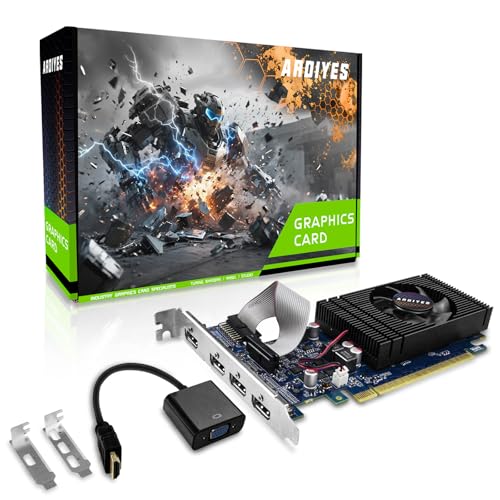
Fan‑cooled options are better for cases with limited airflow or if you push the GPU beyond basic tasks. The ARDIYES GT 740 features a quiet fan that balances cooling and noise. For budget‑conscious builds, passive cards like the ASUS GT 730 eliminate moving parts and potential fan failures.
Final Thoughts
Choosing the right graphics card for four monitors depends on your specific needs: if you prioritize a simple plug‑and‑play experience with four native HDMI outputs, the Xynsviu RX560 4GB GDDR5 4 HDMI Multi Monitor delivers affordable reliability, while those who need a compact, silent solution for a home theater or small office will appreciate the ASUS NVIDIA GeForce GT 730 Graphics Card with its passive cooling and single‑slot design. Both cards handle multi‑monitor productivity with ease, so you can focus on your work rather than on display glitches.
Frequently Asked Questions
Can my computer support four monitors at once?
Yes, if you install a graphics card with at least four video outputs and your operating system supports multiple displays (Windows, macOS, and Linux all do). Your motherboard must have a free PCIe x16 or x8 slot to accommodate the card. Most desktops from the past decade meet this requirement.
Do I need a special cable to connect four monitors?
Standard HDMI, DisplayPort, DVI, or VGA cables work fine. Use the same cable type that matches both your monitor and the card’s port. For longer runs, active cables or signal boosters may be necessary to maintain image quality. Check the maximum resolution supported by each port when using multiple displays.
Will a budget graphics card slow down my system?
Not for typical office or web‑based multitasking. Budget cards like the GT 730 or GT 740 are designed for low‑load scenarios and will not bottleneck your CPU. However, if you run demanding applications across all four screens, consider a card with faster memory and a newer architecture. For a deeper dive into performance expectations, visit our Cards category page.
How much power do these quad monitor graphics cards need?
Most cards in this category draw 30W to 60W from the PCIe slot, so a 300W power supply is usually sufficient. They do not require external power connectors. If you have a particularly old or under‑rated PSU, confirm it meets the card’s minimum wattage. Upgrading to a modern power supply also improves system stability with multiple monitors.