

Your smart home has a dozen devices: lights, thermostats, cameras, speakers. But your old router struggles to keep them all connected. This guide covers the best routers for smart homes in 2026, focusing on WiFi 6 technology that handles many devices at once. We’ve reviewed top picks from TP-Link, ASUS, and FWOOPS to help you choose. For dorm rooms with similar needs, check our guide for dorm routers.


Pros
- Affordable WiFi 6 router that delivers next-generation performance at budget-friendly pricing
- Excellent processor power handles multiple data streams simultaneously for lag-free gaming and 4K streaming
- OneMesh compatibility allows easy network expansion without complex setup or configuration
- Beamforming and MU-MIMO technology maximizes coverage and reduces interference throughout your home
- Universal ISP compatibility and Alexa integration make setup and control effortless
Cons
- 4 Gigabit LAN ports may be limiting for users with many wired devices requiring connectivity
- Entry-level WiFi 6 model lacks some advanced features found in premium routers
- Coverage area may be limited for larger homes or multi-story buildings without mesh extenders
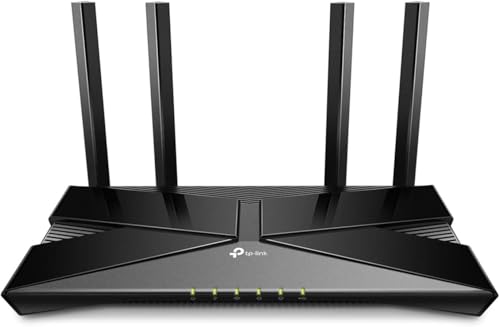
The TP-Link Archer AX10 is an entry-level WiFi 6 dual-band router designed for home users and gamers who want next-generation wireless performance without premium pricing. It combines modern WiFi 6 technology with practical features like OneMesh compatibility, making it an excellent choice for anyone looking to upgrade from older WiFi 5 routers or build an expandable mesh network.
What sets this router apart is its intelligent use of WiFi 6 features like OFDMA and MU-MIMO, which allow it to communicate with multiple devices simultaneously while dramatically reducing network lag. The dual-band setup delivers 300 Mbps on the 2.4 GHz band for basic tasks and extended range, plus a substantial 1201 Mbps on the 5 GHz band for bandwidth-intensive activities like 4K streaming and competitive gaming. The 900 MHz dual-core processor handles these data streams reliably, ensuring smooth performance even during peak usage.
Build quality is solid and functional, with a compact black design that fits unobtrusively into most home setups. The beamforming technology intelligently focuses your WiFi signal toward connected devices rather than broadcasting in all directions, resulting in stronger coverage and fewer dead zones. Setup is straightforward, and the router works seamlessly with all major internet service providers including Verizon, AT&T, Xfinity, and others.
The main limitation is the modest four Gigabit LAN port count, which may constrain users with many wired devices. Additionally, while this router covers typical home sizes effectively, larger homes or buildings may require OneMesh extenders to achieve complete coverage. The feature set, while solid, remains simpler than premium models.
The Archer AX10 delivers impressive value for budget-conscious buyers seeking reliable WiFi 6 connectivity. Its combination of modern technology, mesh compatibility, and dependable performance makes it a smart investment for upgrading your home network without overspending.
Model: TP-Link Archer AX10
Frequency Bands: Dual-Band (2.4 GHz and 5 GHz)
Wireless Standards: 802.11ax, 802.11ac, 802.11n, 802.11g, 802.11b
Speed: 300 Mbps (2.4 GHz) + 1201 Mbps (5 GHz) = 1501 Mbps Total
Processor: Dual-Core 900 MHz
LAN Ports: 4 Gigabit Ethernet ports
Key Features: OFDMA, MU-MIMO, Beamforming, OneMesh Compatible, Parental Control, Guest Mode, WPS, QoS, Access Point Mode, Alexa Compatible
Compatible Devices: Gaming consoles, PCs, smartphones, smart TVs, printers, tablets, security cameras, smart thermostats
Included Components: Router, Power Supply, Quick Installation Guide
Who Should Buy This Router? The Archer AX10 is ideal for households seeking affordable WiFi 6 performance, gamers wanting reduced lag, and users planning to expand their network with OneMesh extenders. It works well for small to medium-sized homes and those with multiple smart devices.
When to Consider Alternatives: If you have a very large home, need extensive wired connections, or require advanced security features, you may benefit from a premium WiFi 6 or WiFi 6E router with more LAN ports and comprehensive management tools.
Setup and Installation: The router is compatible with all major ISPs. Most users complete setup in minutes using the mobile app or web interface. OneMesh extenders integrate seamlessly for expanding coverage to additional rooms or floors.
Performance Expectations: Expect reliable speeds for streaming 4K video, online gaming, and video conferencing. The 5 GHz band delivers maximum speed for devices close to the router, while the 2.4 GHz band provides extended range for devices farther away or in different rooms.

Buying Guide
WiFi 6 Support for Many Devices
Smart homes demand a router that can juggle many connections at once. WiFi 6 technologies like OFDMA and MU-MIMO let the router talk to multiple devices simultaneously, reducing lag. All four products here support WiFi 6, but the TP-Link models and the ASUS RT-AX1800S excel with advanced beamforming and 1024-QAM for faster speeds.
Device Capacity and Performance
How many devices can your router handle? Look for models that promise support for 20+ devices without slowdowns. The LNN-AX3000 from FWOOPS specifically advertises smooth operation for 20+ gadgets, while the TP-Link Archer AX10 uses a tri-core processor to manage data streams efficiently. If you live in a small apartment, our best routers for small apartments list may also help.
Coverage and Beamforming
Routers with multiple antennas and beamforming focus signals toward your devices, improving range and reliability. The TP-Link Archer AX10 and the LNN-AX3000 both use beamforming and external antennas to reach every corner of an average home. For larger spaces, consider EasyMesh support on the LNN-AX3000 to add extra units later.
Security and Parental Controls
Smart home devices can be vulnerable if your network isn’t secure. Look for WPA3 encryption and built-in parental controls. The ASUS RT-AX1800S goes further with AiProtection powered by Trend Micro and a free VPN for remote access. The TP-Link and FWOOPS models also include guest networks and parental controls. For more on router security, visit our Routers category page.
Final Thoughts
For most smart homes, we recommend the TP-Link Wifi 6 AX1500 Smart WiFi Router as a budget-friendly workhorse that handles up to 20 devices with ease and includes solid parental controls. If you need advanced security and VPN capabilities for remote home monitoring, the ASUS RT-AX1800S Dual Band WiFi 6 Extendable is worth the investment, offering commercial-grade protection and future-proof mesh expandability. Either choice will keep your smart home running smoothly for years.
Frequently Asked Questions
Do I need WiFi 6 for a smart home in 2026?
Yes, WiFi 6 is ideal for smart homes because it handles many devices simultaneously and reduces interference. Even if your current devices are WiFi 5, a WiFi 6 router prepares your network for future upgrades.
Can I use a mesh system for my smart home?
Absolutely. Many routers, like the LNN-AX3000, support EasyMesh, letting you add compatible nodes for whole-home coverage. Mesh systems are great for larger homes or areas with thick walls.
How many devices can a smart home router handle?
A good WiFi 6 router can manage 20 to 30 devices without lag. The models we reviewed are optimized for that load, with features like OFDMA and MU-MIMO. For apartments, see our apartment router picks.
Is a budget router enough for a smart home?
Yes, if you choose a WiFi 6 model with at least dual-band support and beamforming. The TP-Link Archer AX10 is a great affordable option that still delivers reliable performance for most smart home setups.


