You are packing for a weekend camping trip, and you realize your phone battery is at 15%. Your headlamp is dimming, and you still need to inflate your air mattress. Without a reliable power source, your outdoor adventure can quickly become a lesson in frustration. This guide reviews the best portable power stations under $300 for 2026, focusing on models from Jackery, ALLWEI, and ZeroKor. Whether you need a lightweight companion for hiking or a backup unit for your home, we have verified top picks for every scenario. For more outdoor essentials, check out our best hiking poles guide.
Product Comparison Shortcode

Pros
- Extremely portable at only 7.5 pounds
- Over 4,000 charge cycles for decade-long reliability
- Multiple output ports including USB-C PD for fast device charging
- Quiet, fume-free operation compared to gas generators
- Fast solar charging capability for off-grid adventures
Cons
- Cannot power high-wattage appliances like refrigerators or air conditioners
- Solar panel not included, requires separate purchase
- Limited capacity may not cover multi-night camping with a portable fridge
The Jackery Explorer 300 is a compact portable power station designed for outdoor enthusiasts and emergency preparedness. With a 292Wh capacity and a weight of just 7.5 pounds, it strikes an excellent balance between power and portability. It is ideal for campers, hikers, tailgaters, and anyone who needs a reliable off-grid power source for small electronics.
Standout features include a LiFePO4 battery that lasts over 4,000 charge cycles, ensuring more than 11 years of use. It can power up to six devices simultaneously through two AC outlets, a 100W USB-C PD port, two USB-A ports, and a car port. Real-world performance is strong: users report it easily handles laptops, drones, cameras, and CPAP machines during camping trips or blackouts.
The design is rugged yet lightweight, with a built-in handle for easy carrying. The plastic enclosure feels durable and withstands outdoor conditions. Fast solar charging (80% in 2.8 hours with a 100W panel) makes it a great companion for off-grid adventures, though the solar panel is sold separately. The unit charges via AC in about 4 hours.
Drawbacks include the inability to run large appliances like refrigerators or air conditioners due to the 300W output. Some users note that for multi-night camping with a portable fridge, the capacity may fall short. Additionally, the solar panel not being included adds to the initial cost if you want full off-grid capability.
Overall, the Jackery Explorer 300 is a top choice for lightweight, reliable portable power. It earns high marks from thousands of users for its build quality, long battery life, and versatility. If you need a compact power station for small devices and occasional off-grid use, this is an excellent investment.

Pros
- Exceptional portability at 6.4 lbs makes it ideal for backpacking, camping, and vehicle storage
- LiFePO4 chemistry offers superior longevity and safety compared to standard lithium batteries
- Fast 60W USB-C charging handles modern laptops and tablets efficiently
- Dual charging capability cuts full recharge time to just 2-2.5 hours for quick turnaround
- Built-in MPPT controller maximizes solar panel efficiency for true off-grid independence
Cons
- 256Wh capacity may be insufficient for power-hungry devices like space heaters or large appliances
- Peak power output of 600W limits simultaneous high-draw device usage despite six ports
- Solar panel sold separately, adding to overall system cost for complete off-grid setup
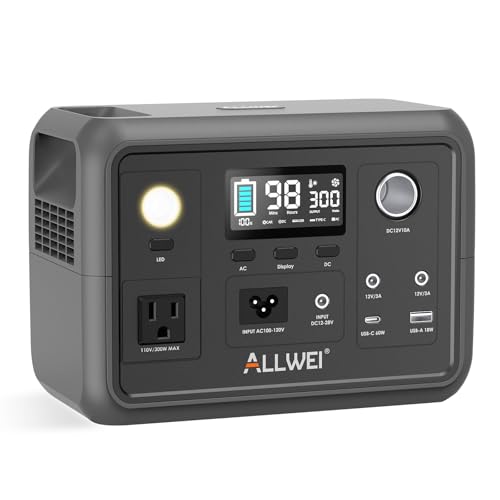
The ALLWEI 300W Portable Power Station is a compact, versatile backup power solution designed for campers, road trippers, and homeowners seeking emergency backup. With 256Wh capacity and 300W continuous output, it handles laptops, mini fridges, CPAP machines, and smartphones without breaking a sweat. This unit bridges the gap between ultra-portable power banks and bulky home generators.
Performance is the standout here. The LiFePO4 battery chemistry guarantees 3000 charge-discharge cycles, translating to roughly a decade of regular use. The pure sine wave inverter safely powers sensitive electronics that cheaper modified sine wave units would damage. Six output ports let you charge up to six devices simultaneously, while the 60W USB-C port handles modern laptops far better than most competitors in this price range. Dual charging capability is genuinely useful, cutting full recharge time to 2.5 hours when combining AC and solar input.
Design and build quality impress for the price point. At just 6.4 lbs and measuring 9.25 x 5 x 6.81 inches, this power station fits easily in backpacks and car trunks. The integrated LED light with SOS mode proves handy during camping trips and power outages. The 6-layer BMS protection and pass-through charging function add confidence for both outdoor and home use scenarios.
The main limitation is capacity. At 256Wh, this isn't meant for running heavy-draw appliances like space heaters or power tools for extended periods. The 600W peak surge rating also means you can't run multiple high-power devices simultaneously despite the six ports. Additionally, solar panels are sold separately, requiring additional investment for true off-grid independence.
Verdict: The ALLWEI 300W delivers exceptional value for casual campers, emergency preparedness, and outdoor enthusiasts. The LiFePO4 battery, fast charging, and multiple ports justify the investment. This is the smart choice if you need reliable, portable power without excessive bulk or cost.
Battery Technology: LiFePO4 (Lithium Iron Phosphate)
Capacity: 256Wh
Continuous Output: 300W
Peak Surge Power: 600W (pure sine wave)
Charge Cycles: 3000 cycles (approximately 10 years)
Output Ports: 1x AC outlet, 2x DC5521 ports, 1x car cigarette lighter port, 1x USB-A fast charge 18W, 1x USB-C PD 60W
Charging Methods: AC wall (3.5-4 hours), 12V car charger (3.5-4 hours), solar panel (4-5 hours with 100W panel), dual charging (2-2.5 hours)
Built-in Features: MPPT controller, 6-layer BMS protection, pass-through charging, 3-level LED light with SOS mode
Physical Dimensions: 9.25 x 5 x 6.81 inches
Weight: 6.4 lbs
Warranty: 5-year manufacturer warranty
Package Includes: Power station, AC cable, DC car cable, user manual
Who Should Buy: Campers and outdoor enthusiasts needing portable emergency power, homeowners building emergency backup systems, road trippers requiring multi-device charging, and off-grid cabin owners seeking supplemental power generation.
Who Should Skip: Users needing to run high-power appliances like space heaters or power tools for extended periods, those requiring 24/7 home backup for entire households, or minimalists unwilling to invest in a separate solar panel for true off-grid capability.
Best Use Cases: Weekend camping trips, vehicle emergency kits, backup power during outages, charging multiple devices on road trips, powering CPAP machines during travel, and supplemental power for small cabins or RVs.
Tips for Maximum Value: Pair with a 100W solar panel for complete off-grid independence, use the pass-through charging feature to charge both the station and devices simultaneously, and leverage the dual AC and solar charging for fastest recharge times. Store in cool, dry conditions and avoid complete discharge for longest battery lifespan.

Pros
- Ultra-fast setup under 60 seconds
- Weather-resistant with waterproof floor and windproof design
- Excellent ventilation with mesh on all sides and ceiling
- Spacious enough for a queen air mattress and gear
- Lightweight and portable at under 20 lbs
Cons
- Inner tent roof is mesh and not waterproof; requires rainfly in wet conditions
- Zipper may catch fabric if not used carefully; follow instructions to avoid jams
- Weight of 19 lbs may be heavy for backpacking, better for car camping
The FanttikOutdoor Zeta C6 Pro is a 6-person camping tent designed for quick and hassle-free setup. With its pre-installed poles and seamless construction, you can have it ready in under 60 seconds, making it perfect for families or beginners who want to maximize time outdoors.
Standout features include waterproof and wind-resistant materials that hold up to 35 mph gusts, plus a tub-style floor with drainage channels to keep water and insects out. The tent offers excellent ventilation with mesh windows on all four sides, floor vents, and a mesh ceiling for stargazing on clear nights.
Built with a carbon steel frame and protective sleeves, the tent is both sturdy and lightweight at 19 pounds. The spacious interior measures 10 by 9 feet with a 66-inch center height, comfortably fitting a queen air mattress and gear for three people. Additional conveniences include SBS zippers, a power cord entrance, and mesh pockets for small items.
One potential drawback is that the inner tent roof is mesh and not waterproof; you must use the included rainfly in rainy weather. Also, the zippers require careful handling to avoid catching fabric. At 19 pounds, it's best suited for car camping rather than backpacking.
Overall, the FanttikOutdoor Zeta C6 Pro delivers on its promise of instant setup and reliable weather protection. It's an excellent choice for families and casual campers seeking a spacious, comfortable shelter without the complexity of traditional tents.
Brand: FanttikOutdoor
Model: Zeta C6 Pro
Color: Khaki
Size: 10' x 9' x 66''
Weight: 19.03 pounds
Capacity: 6 people (sleeping only), 3 people with gear
Setup Time: Under 60 seconds
Water Resistance: Waterproof fabric with tub-style floor
Wind Resistance: Up to 35 mph
Ventilation: Mesh windows on all sides, floor vents, mesh ceiling
Frame Material: Carbon steel with protective sleeves
Zipper: SBS zippers
Special Features: Power cord entrance, mesh pockets

Buying Guide
Battery Capacity and Chemistry
Your power station’s battery capacity determines how long you can run devices. Look for watt-hours (Wh): higher means more energy. For camping, 256Wh to 300Wh is enough for phones, laptops, and small appliances. The type of battery matters too. Lithium iron phosphate (LiFePO4) cells last longer (thousands of cycles) and handle heat better than standard lithium-ion. Both the Jackery Explorer 300 and ALLWEI 300W use LiFePO4, offering a decade of reliable use. For other outdoor gear, see our best lightweight trekking poles.
Output Ports and Power
Check the number and type of ports. AC outlets are essential for laptops and CPAP machines; USB-C PD is great for fast charging modern devices. A 300W continuous output (with a 600W peak) will handle most small electronics. The ZeroKor model includes a solar panel, making it an all-in-one solution. For car emergencies, you might also like our best emergency flashlight for car recommendations.
Portability and Weight
Weight matters if you carry the power station in your backpack. The Jackery Explorer 300 weighs 7.5 pounds. The ALLWEI 256Wh unit is lighter at 6.4 pounds, making it easier to pack. Compact dimensions help it fit in a car trunk or under an airplane seat. Consider what you value: lighter weight means easier hiking, but a slightly heavier unit often offers more ports or capacity.
Charging Flexibility
Look for multiple charging inputs: AC wall, car, and solar. A built-in MPPT controller improves solar efficiency. The ALLWEI supports dual charging (AC + solar) for faster refills. The Jackery can reach 80% in about 2.8 hours with a 100W panel. If you plan to go completely off-grid, a model with a solar panel bundle like the ZeroKor is especially useful. Explore our outdoor category for more camping essentials.
Final Thoughts
After evaluating these three solid options, we recommend the Jackery Explorer 300 Portable Power Station,292Wh for its excellent build quality, long lifespan from LiFePO4 cells, and versatile 100W USB-C port that makes it ideal for digital nomads and campers who need reliable power for laptops and cameras. For budget-conscious users who still want a complete solar setup, the Portable Solar Generator 300W Portable Power from ZeroKor offers great value with its included 60W solar panel, making it a smart choice for weekend trips where you want to stay off-grid without breaking the bank.
Related Guides
- Best Portable Power Station For Power Tools
- 10 Best Solar Generators for Cabins in 2026
- Best Portable Power Station For Off Grid Cabin
- Top Portable Power Stations for the Money in : Jackery vs ALLWEI
Frequently Asked Questions
How long will a portable power station under $300 run a CPAP machine?
With a 292Wh capacity like the Jackery Explorer 300, a typical CPAP machine (around 30W) will run for roughly 9 to 10 hours. For longer trips, consider a model with higher watt-hours or bring a solar panel for daytime recharging.
Can I charge a power station with a solar panel?
Yes, most portable power stations under $300 support solar charging via a built-in MPPT controller. Models like the ZeroKor come with a 60W panel, while the Jackery and ALLWEI allow you to add any compatible solar panel. Charging time depends on panel wattage and sunlight.
What devices can I power with a 300W power station?
A 300W unit can run laptops, smartphones, cameras, mini fridges (under 50W), CPAP machines, and LED lights. Avoid high-wattage appliances like hairdryers, coffee makers, or space heaters, which exceed the inverter’s limit.
How do I maintain my portable power station for long life?
Store the unit in a cool, dry place and keep it charged between 50% and 80% if not used for extended periods. For LiFePO4 models, a full discharge every few months is fine, but avoid leaving it at 0% for weeks. Recharge at least once every 3 months. For more tips, see our top tire pressure gauges for car safety.