You’ve just laid down a killer guitar riff or a soaring synth melody, but when you hit play, the audio through your motherboard’s built-in chip sounds flat, muddy, or has an annoying hiss. For anyone serious about music production, the built-in sound on a typical PC is a bottleneck that crushes your creativity. This guide is for home studio owners, bedroom producers, and audio enthusiasts who want to upgrade their setup with a dedicated sound card in 2026. We’ll break down the top models to help you make an informed choice, and you can also check our guide to the best internal sound cards for a broader look.

Buying Guide: What to Look For in a Music Production Sound Card
Choosing the right sound card for music production goes beyond just picking the most expensive option. You need a card that offers clean, transparent sound with low latency for real-time monitoring. Here are the key factors we considered when evaluating the top models.
Audio Quality and SNR
The signal-to-noise ratio (SNR) and dynamic range are the most critical specs for music production. A higher SNR (measured in dB) means less background hiss and a cleaner signal, which is essential when recording or mixing quiet passages. Look for a card with at least 100 dB SNR to ensure your productions sound professional.
Dynamic range, often quoted alongside SNR, tells you how well the card handles both quiet and loud sounds without distortion. Cards with 120 dB or more are ideal for capturing the full dynamic range of your instruments. For a deeper dive into what makes a great card for studio work, see our top picks for studio recording.
Connectivity and Outputs
Think about what you’ll be connecting. Do you have studio monitors with balanced TRS inputs, or are you using a home stereo with optical input? A good music production sound card should offer a variety of outputs, including 3.5mm jacks, optical (TOSLINK), and coaxial. This flexibility lets you connect to different monitoring setups without needing extra adapters.
Also, consider whether you need a dedicated headphone amp. For critical mixing, a high-quality headphone output with its own amp is a huge advantage. If you plan to record vocals or instruments directly, you’ll also need a card with a clean mic preamp and line-in, which some of the models we’ve reviewed offer.
Sampling Rate and Bit Depth
Music production often requires working with high-resolution audio files. Look for a card that supports at least 24-bit/96kHz, and ideally 24-bit/192kHz or higher. This ensures that your software can handle the full fidelity of your recordings and virtual instruments without downsampling.
While some argue that higher sampling rates are overkill for final delivery, they give you headroom when mixing and applying effects. A card that supports multiple sampling rates (44.1, 48, 96, 192 kHz) is a safe bet for any production environment. For video editors who also need solid audio, our sound card recommendations for video editing might be useful.
Driver Stability and Compatibility
Nothing kills a creative flow faster than a sound card that drops out or causes blue screens. A card with stable, well-maintained drivers is non-negotiable. Look for cards that are class-compliant (plug-and-play) on major operating systems like Windows, macOS, and even Android for maximum flexibility.
Some cards come with proprietary software that offers extra features like EQ and virtual surround, but these can sometimes cause conflicts. For music production, you’ll want a card that works flawlessly with your DAW (Digital Audio Workstation) without extra bloatware. Always check for driver updates before making a purchase.
Final Thoughts
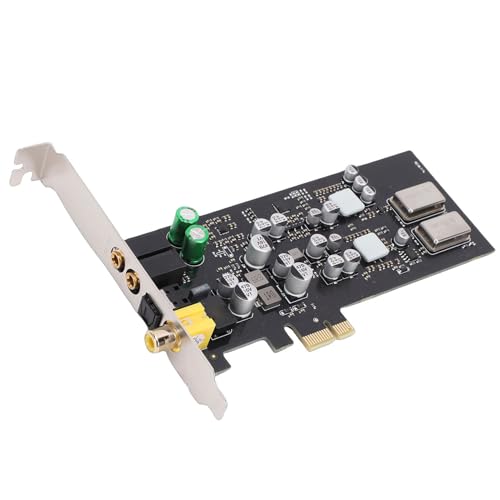
After reviewing the top contenders, the Creative Sound Blaster Audigy Fx Pro Hi-Res PCIe stands out for its high-resolution 32-bit/384kHz playback and versatile connectivity, making it a fantastic all-rounder for any music producer. On the other hand, if you’re looking for a budget-friendly yet feature-packed option with dual DACs and multiple output options, the LICAEVEY PCIE to 5.1 Sound Card is a solid choice that won’t disappoint. Whichever you pick, you’ll notice a significant improvement over your motherboard’s built-in audio.
Frequently Asked Questions
Do I really need a sound card for music production, or is my motherboard enough?
While modern motherboards have improved, they still often suffer from higher noise levels and inferior DACs (digital-to-analog converters) compared to dedicated sound cards. For music production, where accuracy is key, a dedicated card provides cleaner power, better SNR, and lower latency, which are essential for recording and mixing. If you’re serious about your craft, the upgrade is worth it.
What’s the difference between an internal PCIe sound card and an external USB one for music production?
Internal PCIe sound cards typically offer lower latency and higher bandwidth because they connect directly to the motherboard’s bus. They are also less likely to introduce electrical noise from other peripherals. External USB sound cards, on the other hand, are more portable and can be used with laptops, but they may have slightly higher latency and are prone to USB power noise. For a fixed studio setup, an internal card is often the better choice.
Can I use a gaming sound card for music production?
Gaming sound cards often come with features like virtual surround sound and EQ presets that can color the audio, which is not ideal for mixing. However, many modern gaming cards can be set to “direct” or “flat” mode, bypassing these effects. If you’re on a budget, you can use one, but for serious production, a card designed for audio creation with transparent output is recommended. Check out our other card reviews for more options.
What is the ideal SNR for a sound card used in music production?
For music production, you should look for a sound card with an SNR of at least 100 dB, but ideally 110 dB or higher. This ensures that the noise floor is virtually inaudible, even when you boost quiet signals or use high-gain plugins. Cards with an SNR of 120 dB or more are considered excellent and will provide pristine audio quality for your projects.