If you have ever struggled with background noise, low volume, or audio dropouts while making music on your computer, you already know the limits of built-in sound hardware. An external sound card (sometimes called a USB audio interface) bypasses your motherboard’s noisy circuitry and gives you dedicated converters, higher sample rates, and reliable connectivity for microphones, instruments, and headphones. Whether you record vocals, produce electronic beats, or mix multi-track projects, the right external sound card can transform your workflow and the quality of your final output. In this guide, we review seven external sound cards and audio adapters that serve different needs, from budget-friendly plug-and-play solutions to feature-rich surround sound interfaces. If you are evaluating other audio upgrades, you might also check our roundup of top dedicated sound cards for crisp audio for comparison.




Buying Guide: What to Look for in an External Sound Card for Music Production
Audio Resolution and Sample Rate
For music production, you want a sound card that supports at least 24-bit depth and a sample rate of 96 kHz or higher. High-resolution audio captures subtle harmonics and transient details, which matter when mixing stems or applying effects. The Creative Sound Blaster Audigy Fx Pro delivers 32-bit / 384 kHz playback, while the Cubilux 7.1 supports up to 384 kHz on headphones. Avoid cards that only offer 16-bit/44.1 kHz unless you are only doing casual listening.
Input and Output Connectivity
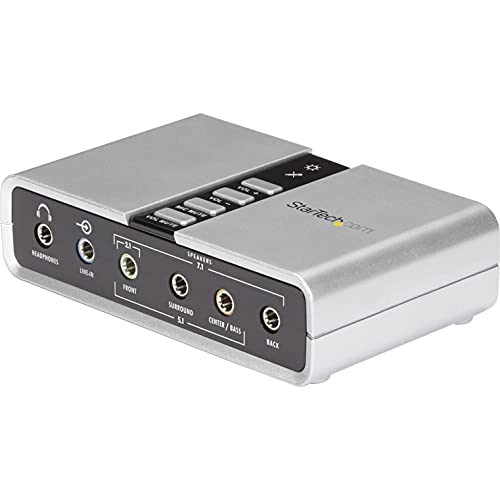
Consider what sources and destinations you need to connect. For recording, you need a dedicated microphone input (ideally with a separate line-in for instruments). For monitoring, look for a headphone output and possibly multiple analog outputs for surround or multi-speaker setups. The StarTech 7.1 USB Audio Adapter provides 5.1 and 7.1 channel output plus a headphone port, while the SINWE Live Sound Card offers multiple microphone inputs and effects controls for streaming or podcasting. If you plan to connect studio monitors, a basic stereo adapter like the SABRENT or VENTION may be too limited.
Latency and Driver Support
Low latency is critical when monitoring live input or recording overdubs. USB audio class compliance ensures plug-and-play on most systems, but some high-performance cards require custom ASIO drivers for the lowest possible delay. Both the Creative Sound Blaster and the Cubilux 7.1 can work with generic class-compliant drivers, but for professional DAW work, confirm that the card supports ASIO or at least delivers acceptable round-trip latency. Our full external sound card guide includes more details on driver performance.
Build Quality and Portability
If you travel between studios or record on location, a rugged metal housing is a plus. The Cubilux 7.1 features a full aluminum alloy case that shields against interference, while the StarTech and SABRENT units are compact plastic designs. A sound card with a volume knob and mute button, such as the VENTION, simplifies desktop control. For a more elaborate production tool, the SINWE includes lights and effects knobs that might appeal to live streamers.
When building a complete music production rig, also consider your computer’s graphics demands. While not directly audio-related, a smooth DAW experience benefits from a capable GPU. Read our recommendations for AI and workstation graphics cards if you also do heavy processing.
Final Thoughts
After reviewing these seven sound cards, it is clear that there is no single “best” option for everyone. If you need high-resolution, surround sound capabilities and a proven interface, the Creative Sound Blaster Audigy Fx Pro Hi-Res PCIe delivers exceptional clarity and flexible channel support. For a portable, affordable USB solution that works with almost any computer, the StarTech 7.1 USB Audio Adapter offers reliable multi-channel output and straightforward controls. Choose the one that fits your studio setup, and enjoy cleaner recordings and more accurate monitoring.
Frequently Asked Questions
Do I need an external sound card for music production if I have a modern laptop?
Most built-in sound chips in laptops are designed for general audio and often produce noticeable noise and high latency. An external sound card bypasses those limitations and provides higher quality conversion, dedicated microphone inputs, and lower latency, all of which are essential for professional music production in 2026.
What is the difference between a sound card and an audio interface?
The terms are often used interchangeably, but an audio interface typically includes multiple inputs (XLR, line) with preamps and instrument inputs, while a sound card may focus on output channels and basic mic input. For recording vocals or instruments, look for a device that combines both roles, such as the SINWE Live Sound Card or a dedicated audio interface.
Can an external sound card improve sound quality for headphones?
Yes, especially if your computer’s headphone jack is noisy or has weak amplification. Many external sound cards, including the Cubilux 7.1 and the Creative Sound Blaster, have dedicated headphone amplifiers and support high-impedance headphones, resulting in clearer, more detailed audio.
Are USB sound cards compatible with all DAWs?
Most USB sound cards are class-compliant and work with any DAW that recognizes ASIO4ALL or the operating system’s audio device. For best performance, some brands offer custom drivers that reduce latency. Check the manufacturer’s specifications for 2026 compatibility with your DAW of choice.